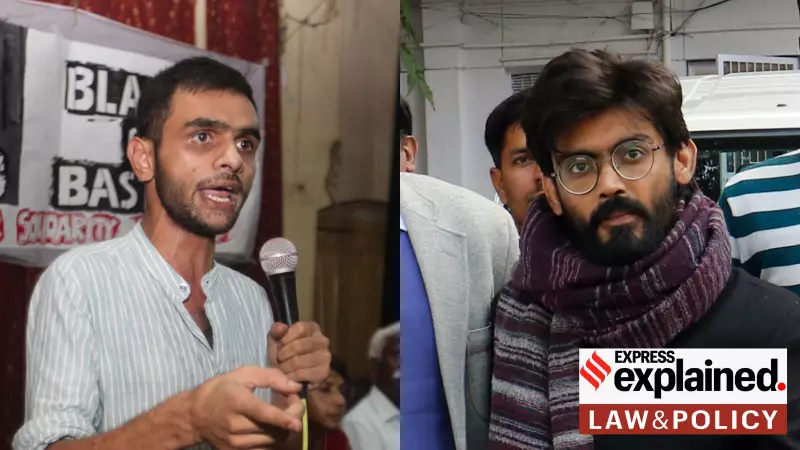
In a significant ruling on Monday, the Supreme Court of India delivered a split verdict in the high-profile 2020 Delhi riots conspiracy case. The apex court denied bail to activists Umar Khalid and Sharjeel Imam while granting relief to five other accused: Gulfisha Fatima, Meeran Haider, Shifa Ur Rehman, Mohd Saleem Khan, and Shadab Ahmed.
The 'Hierarchy of Roles' Framework: Architects vs. Facilitators
A Bench comprising Justices Aravind Kumar and N V Anjaria established a crucial legal framework distinguishing between the alleged 'architects' of the conspiracy and its 'facilitators'. The judgment emphasized an "individualised assessment of culpability," noting a clear differentiation in the hierarchy of the alleged plot.
For Khalid and Imam, the court found that prosecution material, including witness statements, WhatsApp chats, and meeting records, placed them at the level of "conceptualisation, direction, orchestration, or mobilisation." The verdict described them as the "ideological drivers" and "masterminds" who allegedly formulated the strategy to convert protests against the Citizenship (Amendment) Act (CAA) into disruptive road blockades aimed at paralyzing Delhi.
In stark contrast, the five accused granted bail were characterized as "local-level facilitators" or "site-level executors." The Supreme Court reasoned that their roles were "derivative," meaning they acted upon directions from the top tier. Keeping these "minor participants" in indefinite custody, when the investigation is complete and the trial is lagging, was deemed disproportionate.
Expanding the Definition of a 'Terrorist Act' Under UAPA
A pivotal aspect of the ruling concerns the interpretation of what constitutes a "terrorist act" under Section 15 of the Unlawful Activities (Prevention) Act (UAPA). The defence argued that organizing protests and road blockades amounted to political dissent, not terrorism.
The Supreme Court firmly rejected this argument. It clarified that Section 15 is not limited to conventional weapons like bombs or firearms. The definition includes acts using "any other means of whatever nature" likely to threaten India's economic security or disrupt essential services.
The Bench accepted the prosecution's theory that the "sustained choking of arterial roads" and "systemic disruption of civic life" were not benign protests but calibrated acts intended to threaten national unity and integrity. The court held that when such blockades are designed to cause a public order breakdown and are synchronized with international events—like the 2020 visit of then-US President Donald Trump—they prima facie attract the definition of a terrorist act.
Delay in Trial vs. Statutory Bail Bar
All appellants highlighted their prolonged incarceration since 2020, with the trial still at the stage of framing charges. They relied on the SC's 2021 ruling in Union of India v. K.A. Najeeb, which allowed constitutional courts to grant bail under the UAPA if there is no likelihood of a speedy trial, to protect the right to liberty.
However, the court clarified that delay does not operate as an automatic "trump card." It serves as a trigger for heightened judicial scrutiny but must be balanced against the gravity of the offence and the accused's role. The SC also noted the delay was partly due to voluminous evidence—over 1,000 documents and 835 witnesses—and procedural objections from the defence.
For Khalid and Imam, the gravity of the offence and their "conspiratorial centrality" meant the statutory embargo on bail under Section 43D(5) of the UAPA outweighed the delay factor. For the five facilitators, whose roles were limited, the balance tilted in favour of liberty.
Conditions for Bail and the Path Ahead
For the five accused granted bail, the Supreme Court imposed strict conditions. They must execute a personal bond of Rs 2,00,000 with two local sureties, remain within the National Capital Territory of Delhi, surrender their passports, and report to the Delhi Police Crime Branch twice a week. They are also restrained from public commentary on the case and from contacting witnesses.
For Umar Khalid and Sharjeel Imam, the court directed the trial court to proceed with "due expedition." It provided a specific window for them to seek bail again. They can apply before the trial court either upon the completion of the examination of "protected witnesses" or upon the expiry of one year from the date of this order, whichever is earlier.
This ruling underscores the judiciary's nuanced approach in conspiracy cases, weighing individual roles against stringent anti-terror laws while attempting to balance personal liberty with national security concerns.