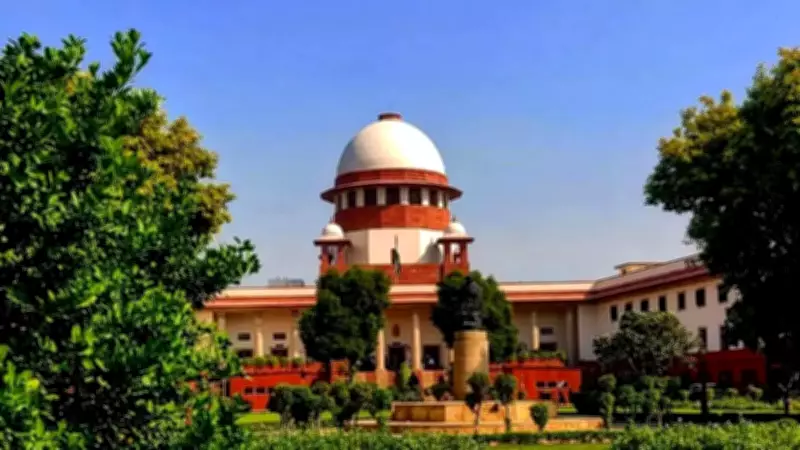
Supreme Court Imposes Strict Limits on Police Arrest Powers Under New BNSS Legislation
The Supreme Court of India delivered a landmark judgment on Thursday, significantly curtailing the discretionary arrest powers of police officers under the newly enacted Bharatiya Nagarik Suraksha Sanhita (BNSS), 2023. The bench emphatically declared that arrests cannot be made simply because it is legally permissible for officers to do so.
Arrest as Last Resort, Not Investigative Tool
A bench comprising Justices M M Sundresh and N K Singh articulated that investigating agencies must refrain from taking accused individuals into custody merely for questioning purposes. The court emphasized that arrests should occur only when absolutely necessary for the investigation process itself.
The bench explicitly stated: "The power of arrest under Section 35(6) read with Section 35(1)(b) of the BNSS, 2023 must be interpreted as a strict objective necessity, and not a subjective convenience for the police officer. It does not mean the police officer can arrest to simply ask questions."
Mandatory Notice Requirement for Lesser Offences
Enumerating various provisions of the BNSS, the court clarified that issuing a notice under Section 35(3) of the law to an accused or any concerned individual—for offences punishable with imprisonment of up to seven years—is now the standard procedure. This notice requirement represents a fundamental procedural safeguard.
Senior advocate Sidharth Luthra, serving as amicus curiae assisting the court, reinforced this position by arguing that the requirement to issue such notice is absolute and cannot be circumvented merely by recording reasons for arrest.
Investigation Without Arrest as General Principle
The Supreme Court established that investigations can and should proceed without arrests in most circumstances. The bench provided clear guidance to police officers: "While undertaking the exercise of collecting evidence for the purpose of forming his opinion over the commission of a cognizable offence, a police officer shall pose a question, to himself, on the necessity of an arrest."
The court further explained that this safeguard exists because the power to arrest remains available to police officers even after they initially record reasons for not making an arrest at an earlier investigative stage.
Arrest as Discretionary Facilitation, Not Mandatory Procedure
In its concluding observations, the bench stated: "An arrest by a police officer is a mere statutory discretion which facilitates him to conduct proper investigation, in the form of collection of evidence, and therefore shall not be termed as mandatory. Consequently, the police officer shall ask himself the question as to whether an arrest is a necessity or not, before undertaking the said exercise."
The court added a crucial qualification: "Even if the circumstances warranting an arrest of a person are available in terms of the conditions mentioned under Section 35(1)(b) of the BNSS, 2023, the arrest shall not be undertaken, unless it's absolutely warranted."
This judgment establishes significant procedural protections for citizens while simultaneously providing clear operational guidelines for law enforcement agencies implementing the new criminal procedure code.