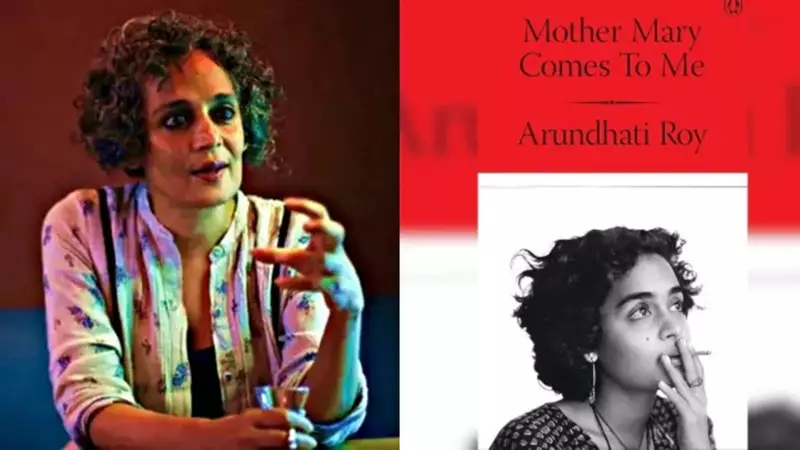
In a significant ruling, the Supreme Court of India on Friday, December 5, 2025, dismissed a petition challenging the cover of author Arundhati Roy's memoir, which features a photograph of her smoking. The apex court's decision brings closure to a legal controversy that questioned whether the book's imagery violated tobacco control laws.
Court Upholds High Court's View, Criticizes Petitioner
A bench comprising Chief Justice Surya Kant and Justice Joymalya Bagchi refused to entertain the Special Leave Petition (SLP). The petition had challenged the Kerala High Court's earlier dismissal of a Public Interest Litigation (PIL) against the cover of Roy's book, Mother Mary Comes To Me. The Supreme Court concurred with the High Court's finding that the image does not breach the Cigarettes and Other Tobacco Products Act (COTPA), 2013.
The bench observed that Roy is an established literary figure and that the book, a personal memoir, does not promote smoking. It also took note of the fact that the publisher, Penguin Random House India, had already placed a clear disclaimer on the cover stating: "Any depiction of smoking in this book is for representational purposes only. Penguin Random House India does not promote or endorse tobacco use."
During the hearing, Senior Advocate Gopal Kumaran, representing the petitioner, argued that the cover lacked statutory health warnings and raised doubts about whether the substance being smoked was tobacco. However, the bench was not convinced. The CJI also remarked on the petitioner's apparent motive, suggesting the litigation was a pursuit of publicity.
Why the Court Found No Violation of COTPA
The Court delivered a clear legal interpretation in its order. It held that the memoir's cover does not amount to an advertisement under Section 5 of COTPA, which strictly prohibits any promotional content for tobacco products. The bench stated, "The book does not constitute any violation of the Cigarettes and Other Tobacco Products Act, 2013… The SLP is dismissed."
This ruling reinforces the distinction between artistic or personal representation and commercial advertisement. The Court effectively recognized that the context of the image—as part of a literary work depicting the author's life—falls outside the ambit of the law designed to curb tobacco promotion.
Kerala High Court's Sharp Rebuke Echoed
The Supreme Court's dismissal aligns with the Kerala High Court's strongly worded order from earlier proceedings. A division bench of Chief Justice Nitin Jamdar and Justice Basant Balaji had rejected the PIL, criticizing it as a misuse of the PIL mechanism.
The High Court had pointed out several critical flaws in the petition:
- The petitioner had not read the book or examined the legal framework.
- He ignored the publisher's disclaimer on the cover.
- He bypassed the expert Steering Committee set up under COTPA to handle violations.
- His arguments contained irrelevant accusations and "suppression of material facts."
Labeling the PIL as "misconceived" and "legally unsustainable," the High Court stated that courts must ensure PILs are not used for self-publicity or personal slander. The Supreme Court, while agreeing with this reasoning, noted that the High Court had been "merciful" in its treatment of the petitioner.
Focus Returns to Roy's Memoir Itself
Overshadowed by the legal debate is the content of Mother Mary Comes To Me, which is Arundhati Roy's first memoir. The book is a sweeping narrative that traces her life from a childhood in Kerala to adulthood in Delhi. At its heart is an intimate exploration of her complex relationship with her mother, Mary Roy, the celebrated educator and activist known for her landmark legal fight for equal inheritance rights for Syrian Christian women.
Written in the emotional aftermath of her mother's death, the memoir blends personal memory with political history, marked by Roy's signature lyrical prose. It is described as an ode to freedom and a tribute to a "thorny love" that shaped the author into the writer and person she is today.
The Supreme Court's verdict ensures that the focus can now rightly return to the literary and personal significance of the work, rather than a contentious debate over its cover image.