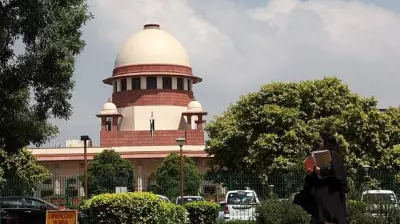
Supreme Court Rejects Mizo Chiefs' Land Compensation Claims
The Supreme Court of India has delivered a significant judgment, dismissing a writ petition filed by the Mizo Chief Council. The petition alleged that the Union of India acquired lands belonging to tribal chieftains in the former Lushai Hills district, now known as Mizoram, without providing adequate compensation.
Judicial Bench and Petition Details
The judgment was pronounced last Wednesday by a bench comprising Justice JB Pardiwala and Justice R Mahadevan. The petition was formally submitted by L. Chinzah, who serves as the president of the Mizo Chief Council. He filed the case on behalf of former tribal chieftains and their legal heirs, arguing that these chiefs were unjustly deprived of their land without receiving any compensation.
The petitioners contended that this deprivation violated their fundamental right to property, which was protected under Article 19(1)(f) and Article 31 of the Indian Constitution at the relevant historical time. The court acknowledged that the claims originated during a period when the right to property was indeed recognized as a fundamental right. However, the bench ultimately held that the petitioners failed to provide sufficient evidence to prove any actual violation of these constitutional provisions.
Rejection of Princely State Comparison
In their arguments, the former chiefs attempted to draw a parallel between themselves and the rulers of erstwhile princely states under British colonial rule. They asserted that they should be entitled to similar treatment and privileges. The Supreme Court firmly rejected this claim, providing a detailed legal rationale for its decision.
The bench stated, "However, this assertion, much like its above claims, is entirely devoid of any legal basis and thereby merits outright rejection. The privy purses and other privileges granted to the erstwhile rulers of the Princely States were the direct outcome of specific, pre-constitutional political and contractual arrangements negotiated between those rulers and the Government. Consequently, it would be legally flawed to equate and elevate these entitlements to the status of a right, which all erstwhile rulers were constitutionally bestowed upon."
The court further emphasized that such political arrangements cannot be claimed as a matter of a legally enforceable right, much less a fundamental right. This clarification underscores the distinct legal frameworks governing different historical entities within India's constitutional evolution.
Historical Context and Land Administration
The case centered on the historical role of Mizo chiefs, who the council described as absolute owners of village lands referred to as “Ram.” According to the petition, these chiefs administered these lands, exercised executive and judicial authority, allocated farmland to villagers, and received “Fathang”—a customary tribute typically paid in paddy.
The court meticulously traced the background to the British annexation of the Lushai Hills in the 1890s. It noted that the colonial administration retained the chieftainship system primarily for administrative convenience. Under this structure, chiefs functioned within a framework controlled by the chief commissioner of Assam and various district officials.
Post-Independence Legal Framework
Following India's Independence, the Lushai Hills remained under the administrative jurisdiction of Assam. The Assam legislature subsequently enacted the Assam Lushai Hills District (Acquisition of Chief’s Rights) Act in 1954. This legislation was specifically designed to acquire the rights and interests of chiefs over land in the district.
Under this law, the state government was empowered to issue notifications transferring a chief’s rights in his “Ram” to the state. The legislation permanently extinguished the chiefs’ powers and land rights, but it did so with provisions for compensation payments. The court's dismissal implies that the legal processes outlined in this act were followed appropriately, and the petitioners' claims of non-payment could not be substantiated.
This judgment reinforces the legal principles surrounding land acquisition and compensation in India, particularly in the context of historical tribal administrations. It highlights the judiciary's role in interpreting constitutional rights within specific historical and legislative frameworks, ensuring that claims are evaluated based on concrete evidence and established legal precedents.