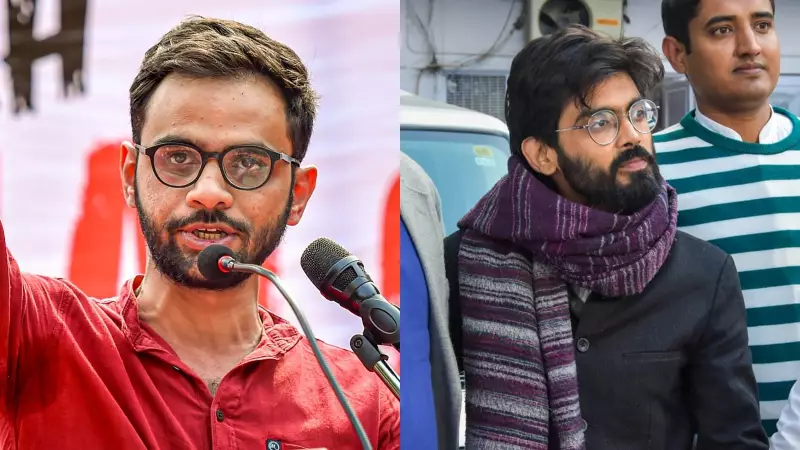
The Supreme Court of India on Monday delivered a split verdict in the high-profile 2020 Delhi riots conspiracy case, denying bail to student activists Umar Khalid and Sharjeel Imam while granting relief to five other accused. The decision has ignited a sharp political divide, with Left parties launching a scathing critique of the order and the ruling Bharatiya Janata Party (BJP) welcoming it, while major opposition parties like the Congress maintained a conspicuous silence.
A Divided Verdict from the Apex Court
A two-judge Bench of the Supreme Court ruled on the bail pleas of multiple individuals accused under the stringent Unlawful Activities (Prevention) Act (UAPA) in connection with the conspiracy allegations surrounding the 2020 Delhi communal violence. While Umar Khalid and Sharjeel Imam saw their bail pleas rejected, the court ordered the release of Gulfisha Fatima, Meeran Haider, Shifa Ur Rehman, Mohammad Salim Khan, and Shadab Ahmad.
The contrasting outcomes have placed the spotlight squarely on the prolonged incarceration of Khalid and Imam, both of whom have spent over five years in jail without the commencement of their trial. This lengthy pre-trial detention has become the central point of contention and criticism from civil society and several political quarters.
Left Parties Condemn "Blatant Negation of Justice"
The Communist Party of India (Marxist) led the charge against the Supreme Court's decision. In an official statement, the CPI(M) asserted that the continued denial of bail to the two activists was "against the principles of natural justice". The party accused the government of exploiting the UAPA law to "crush dissent."
CPI(M) Rajya Sabha member John Brittas highlighted a stark contrast in the judicial system's approach. He pointed out that while Khalid languishes in jail without trial, convicted rapist and murderer Gurmeet Ram Rahim Singh has been granted parole multiple times. "One languishes indefinitely without trial; the other enjoys repeated 'jail vacations' on demand," Brittas remarked, questioning the application of the principle that "bail is the rule, jail the exception."
The Communist Party of India (CPI) echoed these sentiments. Party general secretary D. Raja stated that "more than five years in jail without a trial is not justice, but it is punishment without adjudication." He argued that the denial of bail exposes a "disturbing double standard" in India's criminal justice system. CPI Rajya Sabha MP P. Sandosh made a similar comparison, noting it was "very unfortunate" that former MLA and Unnao rape case accused Kuldeep Singh Sengar could get bail, while student leaders were denied it.
The central committee of the CPI(ML) Liberation went a step further, calling the denial of bail after five years of detention a "blatant negation of the very idea of justice and constitutional liberty of Indian citizens."
Political Reactions: BJP's Support vs. Opposition's Silence
The political response to the court order was sharply polarized. The BJP openly supported the verdict and targeted Khalid and Imam. On the other hand, the Congress, Samajwadi Party, Shiv Sena (UBT), and the NCP (SP) did not issue any official statement on the matter, marking a notable silence from a large section of the opposition.
However, some opposition voices did speak up. Trinamool Congress (TMC) MP Sagarika Ghose criticized the apex court, stating that the order in Umar Khalid's case "only shows how the apex court is repeatedly diluting the right to life and liberty." Rashtriya Janata Dal (RJD) leader Manoj Kumar Jha said the bail denial raised "troubling questions," suggesting the judicial view in their case did not find the delay in trial "shocking or unconstitutional" enough.
Interestingly, Congress leader and senior advocate Abhishek Manu Singhvi, who represented accused Gulfisha Fatima, expressed satisfaction that his client had been granted bail.
The Supreme Court's order has reignited the debate on the use of UAPA, the right to a speedy trial, and the granting of bail in cases involving allegations of terrorism and national security. With the trial yet to begin for the key accused, the legal and political discourse around this case is set to continue.