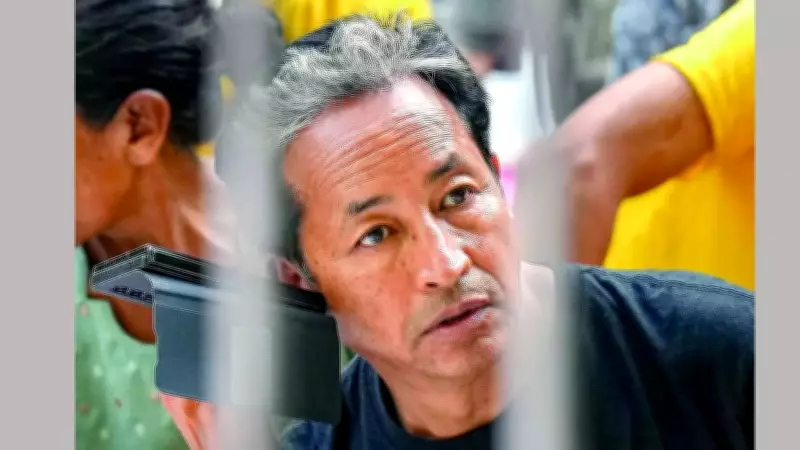
Supreme Court Voices Concern Over Climate Activist's Health, Asks Centre to Reconsider Detention
The Supreme Court of India has raised serious concerns about the medical condition of prominent climate activist Sonam Wangchuk, who has been in detention for over four months under the National Security Act. During a hearing on Wednesday, the apex court explicitly asked the Central government to rethink and relook its decision to continue keeping him in custody.
Medical Examination and Health Deterioration
The court had previously directed authorities to conduct a thorough medical examination of Wangchuk by a specialized doctor and submit a detailed report. This medical report, which was presented before the Supreme Court during the latest hearing, indicated that the activist's health condition is not very good and has been deteriorating. Wangchuk is currently lodged in Jodhpur jail, where his detention has now extended beyond five months.
A bench comprising Justices Aravind Kumar and P B Varale emphasized the urgency of the situation, stating, "The detention order was passed on September 26, 2025. Nearly five months have passed. Considering the health condition of the detainee... which is certainly not very good. There are certain age-related issues, maybe otherwise. Is there a possibility for the government to rethink, have a relook?"
Legal Proceedings and Government's Stance
The Supreme Court is currently hearing a plea filed by Wangchuk's wife, Gitanjali Angmo, challenging his preventive detention. The activist was detained on September 26 last year following protests in Leh that demanded statehood and Sixth Schedule status for Ladakh.
During the proceedings, the bench also directed the government to produce the original files related to Wangchuk's detention and the process adopted by authorities. Additional Solicitor General K M Natraj, representing the Centre, assured the court that the government has nothing to hide and would place all relevant documents before the judiciary.
Government's Justification for Detention
Natraj presented the government's position, arguing that Wangchuk's speech on September 24 last year was provocative and directly led to violent protests that resulted in four fatalities and 161 injuries. He submitted, "Ultimately, it was his provocative speech, his instigation, which led to violence. The person need not be actively participating in it. It is the propensity of the person to influence the group of people or to commit somebody else to do a violent act which is relevant. That is more than sufficient for preventive detention."
The Additional Solicitor General further clarified the legal framework, stating, "The National Security Act is only a preventive law. It is only to prevent somebody from acting in any manner prejudicial to the maintenance of public order or security of the state. Preventive detention is not punitive detention. It has to be necessarily left to the discretion of the executing authority. It is purely discretionary."
Broader Context and Previous Allegations
Earlier in the legal proceedings, the government had informed the court that Wangchuk was allegedly attempting to create political and social turmoil in Ladakh. Authorities claimed he was making efforts to emulate situations seen in neighboring countries like Bangladesh, Sri Lanka, and Nepal, though specific evidence supporting these claims has not been publicly detailed.
The Supreme Court's intervention highlights the ongoing tension between national security concerns and individual rights, particularly when detainees' health becomes compromised. The bench's request for the government to reconsider the detention reflects judicial concern for humanitarian aspects within preventive detention cases.
Natraj has committed to taking instructions from the government and briefing the court on the next hearing date. The case continues to draw significant attention as it intersects climate activism, regional autonomy demands, and legal interpretations of national security provisions.