In an unexpected act of compassion, Maharashtra's anti-Naxal police apparatus facilitated the final journey home of a deceased Maoist commander, bridging a decades-old divide in the conflict-ridden Gadchiroli region. The body of Kopa Mahaka, 65, was transported over 450 kilometers from a Nagpur hospital to his remote village, a gesture that has quietly resonated in the Red corridor.
From Prison Cell to Final Resting Place
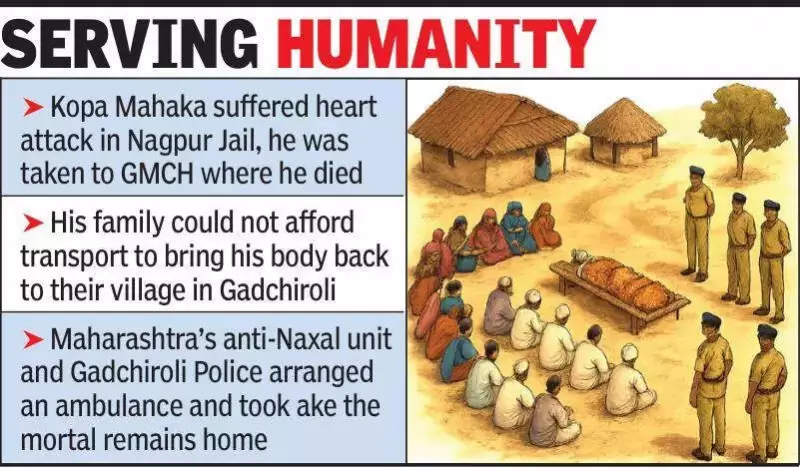
The story began four days ago when Mahaka, a tribal from the sensitive Bhamragarh taluka of Gadchiroli, complained of chest pain in his Nagpur prison cell. He was rushed to the Government Medical College and Hospital (GMCH) but succumbed to a heart attack. Arrested in 1992 and convicted in 2004 under the now-scrapped Terrorist and Disruptive Activities (Prevention) Act (TADA), Mahaka was serving a life sentence. His crime was aiding Maoists in setting up a guerrilla-style ambush on a police party at Laheri on the Maharashtra-Chhattisgarh border in 1991.
Faced with the news of his death, Mahaka's family in Kucher village, on the foothills of the tottering Maoist headquarters of Abujmarh, found themselves in despair. They had no financial means to hire a private vehicle or ambulance to bring his body home for the last rites. In their desperation, they turned to the prison authorities for help.

A Chain of Compassion: The Police Response
The plea set in motion a rare humanitarian operation. Additional Superintendent of Nagpur Central Jail, Deepa Agey, contacted Inspector General of Police, Sandip Patil, who heads Maharashtra's Anti-Naxal Operation Cell. Recognizing the situation's sensitivity, Patil directed the Gadchiroli Police to mobilize resources.
Within hours, an ambulance was arranged to carry the mortal remains from Nagpur to Gadchiroli. From there, a special vehicle with a police escort undertook the challenging task of navigating forest roads and multiple security checkpoints to reach the remote hamlet of Kucher. This 450-kilometer journey, through the heart of a region where commando operations against Maoists continue, was completed respectfully.
Quiet Rites and a Shift in Perception
The arrival of the body at Kucher village was an emotional moment. Mahaka's family broke down, and police personnel stood by silently as villagers performed the last rites. This quiet operation, conducted amidst a backdrop of mutual mistrust built over decades, has earned quiet praise.
Additional Superintendent of Police M Ramesh clarified the force's stance, stating, "This was purely a humanitarian task. We fight armed guerrillas, not grieving families. We are always ready to serve humanity." The gesture underscores a complex reality in India's internal security challenges, where lines between adversary and civilian are carefully drawn in moments of personal tragedy.
The final journey of Kopa Mahaka, who once tried to blow up a police vehicle, ironically completed in a police-arranged vehicle, serves as a poignant chapter in the long and fraught narrative of the region.