Noida Tragedy: 27-Year-Old Techie Drowns as 80 Rescuers Fail to Save Him
In a heartbreaking incident that has sent shockwaves through Noida, a 27-year-old software engineer named Yuvraj Mehta drowned last Friday night while trapped in a waterlogged trench near his residence. Despite an overwhelming response from multiple emergency agencies totaling 80 personnel, the young techie could not be saved, exposing what his father and experts are calling an "institutional failure" of the rescue mechanism.
The Fateful Night: A Desperate Struggle for Survival
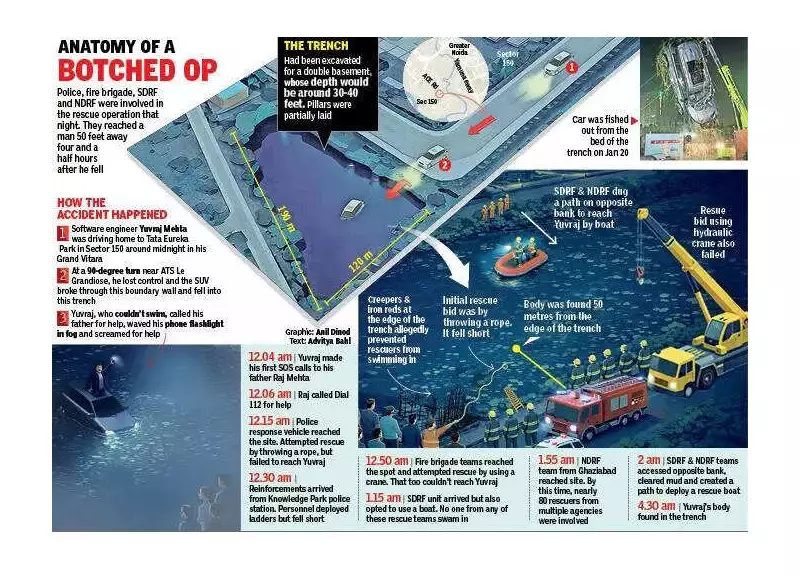
When Yuvraj Mehta screamed for help around midnight on January 16, marooned in a waterlogged trench and clinging to his slowly sinking car, his distress call triggered a massive emergency response. His father, Raj Mehta, immediately alerted police, setting in motion a chain of events that would bring police patrol teams, fire brigade personnel, State Disaster Response Force (SDRF) units, and ultimately National Disaster Response Force (NDRF) teams to the scene in Sector 150.
By all accounts, Yuvraj fought valiantly for survival. The young engineer, who did not know how to swim, managed to stay afloat until approximately 1:30 AM, frantically waving his phone flashlight in hopes of attracting attention on a densely foggy night. His cries eventually stopped as rescue teams struggled with indecision and protocol issues.
Institutional Collapse: Multiple Agencies, Zero Coordination
Former Uttar Pradesh DGP Vikram Singh echoed Raj Mehta's assessment, describing the incident as "nothing short of institutional collapse." He emphasized that the victim succumbed to the accident despite numerous onlookers being unable to help due to "lack of skill, lack of equipment or lack of bravery."
What makes this tragedy particularly disturbing is that rescuers would have needed to wade no more than 50 meters to reach Yuvraj. Yet, only a passing delivery rider attempted to swim through the icy water to save him. Official sources cited thick fog and protruding iron rods from submerged pillars as obstacles, but experts argue these challenges should have been surmountable with proper training and equipment.
Critical Gaps in Emergency Response Systems
The incident has revealed fundamental deficiencies in India's emergency rescue mechanisms across multiple dimensions:
First Responder Training Deficiencies
Police response vehicles reached the scene within nine minutes of the emergency call at 12:06 AM. However, despite claims that all inspectors, sub-inspectors, and assistant sub-inspectors receive swimming and disaster response training, none of the initial responders entered the water. Former UP DGP OP Singh noted that while police are trained for routine emergencies, this situation demanded more specialized skills that were clearly lacking.
Equipment Shortcomings
Dial 112 police response vehicles carry a standard set of tools including ropes, fire extinguishers, and first aid kits, but notably lack life jackets. In cities where civic lapses regularly create dangerous situations like open drains and manholes, this absence represents a critical oversight. Experts argue that first responders should be equipped with life jackets, life support systems, oxygen cylinders, and collapsible boats as standard equipment.
Protocol and Escalation Failures
The emergency response followed established protocols but revealed a system operating in silos. The fire department arrived approximately 45 minutes after the accident, while NDRF teams reached nearly two hours later. Fire officials admitted their personnel are primarily trained for firefighting and surface rescue, not underwater operations. SDRF personnel, specifically trained for such situations, also hesitated to dive in, instead spending two hours preparing a boat approach from another side of the trench.
Leadership Vacuum at the Scene
With four different agencies operating independently at the accident site, there was no unified command structure. Former DGP OP Singh emphasized that had a senior official taken charge, coordination would have improved significantly. Retired Army Colonel Inderjit Singh suggested civilian agencies could replicate military emergency response protocols, where command posts coordinate all resources and maintain helicopters on standby for rapid deployment.
Systemic Solutions Needed
The tragedy has highlighted several urgent reforms needed in emergency response systems:
- Specialized Emergency Cells: Experts recommend creating specialized police emergency response cells in major cities with trained divers, welders, and firefighters who can mount quick rescue operations before specialist teams arrive.
- Enhanced District Capabilities: Former IAS officers note that District Disaster Management Authorities have powers under the Disaster Management Act to form emergency response cells with trained personnel and proper equipment.
- Equipment Upgrades: Police departments need to equip first responders with comprehensive rescue gear including life jackets, hydraulic equipment, breaking tools, and medical systems.
- Training Overhaul: First responder training must expand beyond routine emergencies to include challenging scenarios like deep water rescues in adverse weather conditions.
As investigations continue and questions remain unanswered about why Noida's District Disaster Management Authority wasn't among the first responders, this tragedy serves as a stark reminder that having multiple agencies is meaningless without proper coordination, equipment, training, and leadership. The loss of Yuvraj Mehta's life represents not just a personal tragedy for his family, but a systemic failure that demands immediate corrective action to prevent similar incidents in the future.