

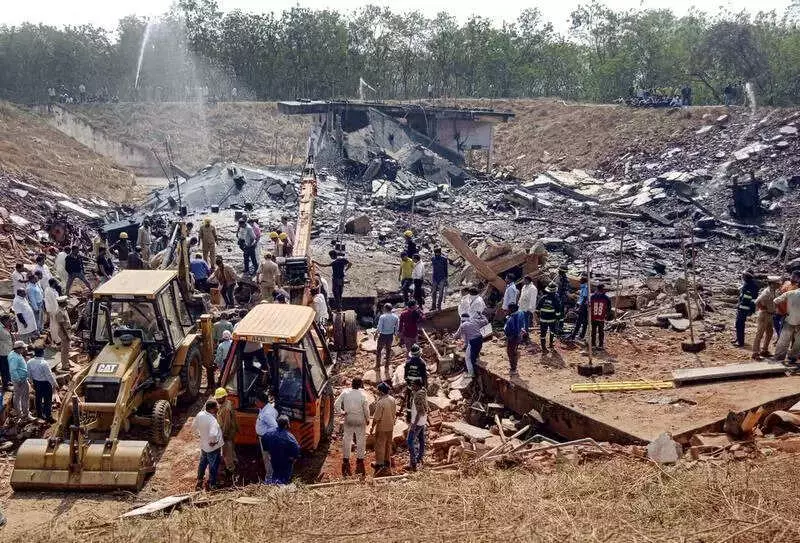
In a significant ruling, the National Green Tribunal (NGT) has mandated criminal proceedings against the administration of the Ordnance Factory in Bhandara, Maharashtra. The tribunal found that the deadly explosion last year, which claimed nine lives, resulted from a failure to adopt safe practices at the defence explosives unit.
Systemic Failures Behind the Tragedy
The NGT's Western Zone bench in Pune, comprising Justice Dinesh Kumar Singh and expert member Sujit Kumar Bajpayee, delivered a detailed judgment on Monday. The bench held Pune-based Munitions India Limited (MIL), the operator of the Bhandara facility, squarely accountable for grave violations of safety norms. This factory manufactures high-grade explosives for the Indian Army.
The tribunal took up the case on its own motion, prompted by a news report in The Times of India on January 24, 2025. The catastrophic blast occurred on that same day at around 10:40 am in the Low Temperature Plastic Explosive (LTPE) section of Building PE-23. The force of the explosion caused the structure to collapse, trapping 13 workers under debris. Eight workers died on the spot, while a ninth succumbed to his injuries on February 28.

Key Lapses and Violations Uncovered
Relying on affidavits from the Directorate of Industrial Safety and Health, the NGT recorded multiple critical failures. It stated that standard operating procedures were ignored and necessary provisions to prevent solidification of material—which could lead to an explosion due to adiabatic compression—were not in place.
In a shocking revelation, the bench noted that two untrained trade apprentices were present at the site during the hazardous operation. Their deployment was a clear breach of protocol, as they were neither trained nor supposed to be involved in such dangerous work.
"These lapses on part of Munitions India Limited resulted in the occurrence for which it should be held accountable," the tribunal asserted. It confirmed a clear contravention of Section 7A(2)(a) of the Factories Act, 1948.
Tribunal's Directives and Environmental Impact
The NGT has directed the Bhandara Collector to ensure the initiation of criminal proceedings against the factory occupier, subject to mandatory approval from the Central Government. While acknowledging that substantial compensation, ex-gratia payments, and compassionate appointments were provided to the victims' families, the bench emphasized that accountability for safety violations could not be diluted.
In a stern order, the tribunal stated, "The Munitions India Limited shall not be allowed to operate unless the suggestions by way of remedial measures are implemented."
Environmental regulators also faced criticism. The Maharashtra Pollution Control Board informed the tribunal that air quality monitoring after the blast revealed pollution levels exceeding permissible limits. This led to the issuance of closure directions on February 25, 2025, which the NGT upheld.
Disposing of the case, the tribunal concluded that the tragedy was not an isolated accident but the direct outcome of systemic safety failures at one of the nation's most sensitive industrial installations.
Key takeaways from the NGT order:

- Munitions India Ltd held accountable for failing to adopt a safe system of work.
- Blast on January 24, 2025, killed 8 instantly; 1 died later.
- SOPs were violated, and safeguards against adiabatic compression were missing.
- Untrained apprentices were illegally deployed in hazardous operations.
- Contravention of the Factories Act, 1948 confirmed.
- Bhandara Collector to ensure a criminal case after central government approval.
- Factory operations barred until safety measures are implemented.
- MPCB's closure directions upheld due to exceeded air pollution norms.





