Nagpur's Radhe Mangalam Square: A Deadly Junction Exposing Systemic Safety Failures
Two tragic fatal accidents occurring within just fourteen days have brutally exposed the glaring and dangerous safety deficiencies at Radhe Mangalam Hall Square on Nagpur's Inner Ring Road. The official response to these incidents has, unfortunately, generated more questions and public anxiety than genuine reassurance, highlighting a disturbing pattern of negligence.
Inadequate Measures and Public Outrage
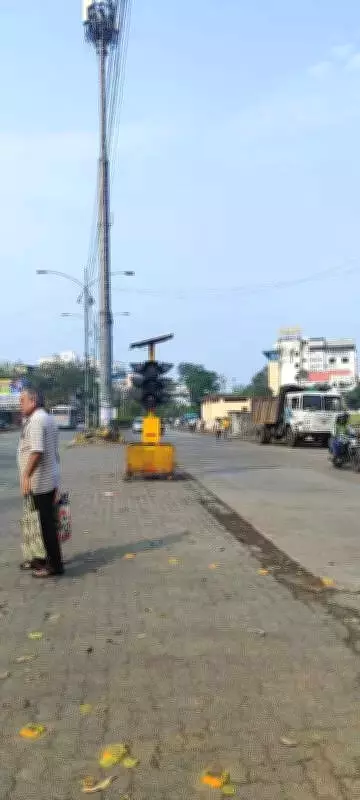
Following intense public outcry after the accidents, authorities installed a temporary solar-powered traffic signal at the hazardous junction. However, in a move that epitomizes the systemic failure, this signal was found to be completely non-functional the very next day. It was subsequently removed for charging, leaving the dangerous crossing once again without any electronic regulation.
As a precautionary step, traffic police also placed barricades on both approaches to Radhe Mangalam Hall Square in an attempt to control speeding vehicles. Local residents, however, report that these barricades are frequently removed soon after installation, rendering the measure largely ineffective. Some community members have even suggested that the crossing at this notoriously busy junction should be permanently closed to prevent further loss of life.
The Tragic Incidents: A Timeline of Neglect
The first fatal accident struck on February 7th. An illegal bike-taxi rider, carrying a passenger, collided with a moped at the square. All three individuals fell onto the roadway. In the ensuing chaos, an SUV ran over the bike-taxi rider, Vivek Borkar, killing him instantly at the scene.
Merely two weeks later, on February 21st, tragedy struck again. An allegedly speeding car lost control and ran over 61-year-old Bhagyashree Kathiwan. She later succumbed to her injuries. These are not isolated events. Locals confirm that apart from these two fatalities, several other serious accidents, including a collision between a car and a truck, have recently occurred at the same spot.
"There are no proper traffic safety measures at the spot leading to accidents regularly," a frustrated local resident stated, echoing the community's fear and anger.
Official Admissions and Systemic Blame Game
Speaking to the press, Sonegaon Traffic Police Inspector Pravin Pandey provided details that underscore the administrative paralysis. He confirmed the temporary signal was brought to the spot but was non-functional as it was not charged. "It is not charged yet, so we asked the hall authorities to help charge it, because of which it was removed. If it does not work, we will bring another temporary signal," Pandey explained.
Regarding the barricades, PI Pandey admitted, "We put up barricades but they were removed the next day. We deployed two personnel to ensure barricades are placed there all the time." His statements reveal a reactive and patchwork approach to a chronic problem.
Broader Infrastructure Neglect on Inner Ring Road
PI Pandey highlighted that the safety crisis extends beyond this single junction. He stated that several stretches along the Inner Ring Road, between Chhatrapati Square and Hingna T-point, critically lack adequate safety infrastructure.
The police have formally written to multiple agencies requesting urgent action, with no results. Letters were sent to the Public Works Department's World Bank division, which holds jurisdiction over the road, urging the installation of essential measures like speed breakers and rumble strips. The Nagpur Municipal Corporation (NMC) was also contacted regarding the absence of basic road markings, including a vital zebra crossing at the Radhe Mangalam junction.
"Apart from the letters, we are regularly in contact with the agencies, but still no action is being taken," PI Pandey concluded, painting a picture of bureaucratic inertia that continues to endanger lives daily. The situation at Radhe Mangalam Square stands as a stark indictment of failed coordination and priority-setting in urban traffic safety management.