Nagpur High Court Upholds Seriousness of Minor Trafficking Allegations
The Nagpur bench of the Bombay High Court has delivered a significant ruling by refusing to quash a criminal case involving the alleged trafficking of a minor girl against a city-based father-son duo. Justice Pravin Patil firmly dismissed two applications filed by a chartered accountant and his businessman father, who were challenging the case registered at Beltarodi police station.
Court Rejects Quashing Based on Disputed Evidence
In a decisive observation, the court stated that "quashing cannot be permitted on the basis of disputed documents whose validity is itself in question." This principle underscores the judiciary's stance that criminal proceedings must not be derailed by contested evidence during preliminary stages.
The case involves serious offences under:

- The Indian Penal Code (IPC)
- The Immoral Traffic (Prevention) Act
- The Protection of Children from Sexual Offences Act (POCSO)
Background of the Case and Police Operation
The prosecution's case originates from a police raid conducted on February 12, 2024, at a hotel where a minor girl was allegedly found with a customer during a carefully planned decoy operation. Key evidence included the seizure of marked currency notes, which led to the registration of offences against multiple accused individuals.
Investigators presented a compelling argument that while the hotel was formally rented to a co-accused, the petitioners were actively involved in facilitating illegal activities for monetary gain. The prosecution built its case on:
- Detailed witness statements
- Comprehensive spot panchanama
- Extensive call detail records
These elements collectively suggested the petitioners' role in supervising operations and maintaining oversight of the alleged illegal activities.
Defence Arguments and Judicial Scrutiny
The defence team argued false implication, contending that mere ownership of the premises through a lease agreement did not establish "knowledge or participation" in any criminal activity. They relied heavily on a prior bail order which stated that "even if entire case of the prosecution is accepted, it nowhere shows the petitioners were running a prostitution business."
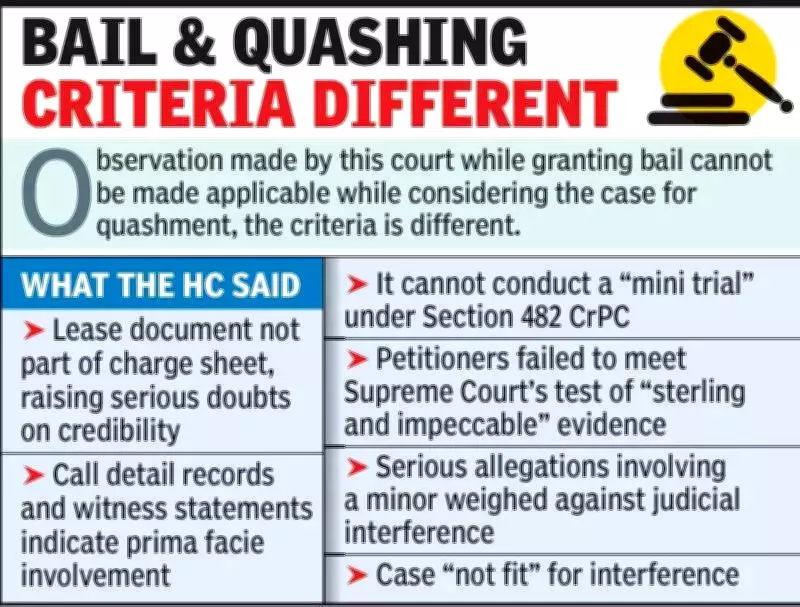
However, Justice Patil clarified this critical distinction: "observation made by this court while granting bail cannot be made applicable while considering the case for quashment, the criteria is different." This judicial clarification highlights how different legal standards apply at various stages of criminal proceedings.
Court's Analysis of Documentary Evidence
The judge found the defence's reliance on a memorandum of understanding dated January 1, 2024, to be particularly unconvincing. The court noted several concerning aspects:
- The document was neither part of the official chargesheet
- It was not produced during the investigation phase
- Signatures showed inconsistencies
- Absence of financial consideration raised questions
- Delayed production undermined its credibility
Based on these observations, the court held that such material could not form the basis for quashing proceedings. "The material relied upon by the petitioners does not rule out the assertions contained in the charges," the court observed, emphasizing that the evidence failed to conclusively negate the prosecution's allegations.
Prima Facie Grounds and Judicial Restraint
The judge further noted that call records and witness statements indicated continued communication and operational oversight, providing sufficient prima facie grounds to proceed with the case. Citing established legal principles, Justice Patil added that "this court cannot conduct a mini trial at this stage to decide whether the petitioners are involved in the crime or not."
This statement reinforces the judiciary's appropriate restraint during preliminary proceedings, where the focus remains on whether allegations warrant further investigation rather than determining ultimate guilt or innocence.

Serious Allegations Demand Judicial Scrutiny
Emphasizing the gravity of allegations involving a minor, the court held that this was "not a fit case for any interference" under its inherent powers. The dismissal of both applications without costs sends a clear message about the seriousness with which courts approach cases involving child protection laws.
This ruling serves as an important precedent, reinforcing that cases involving minors and serious allegations under special statutes like POCSO require thorough judicial examination rather than premature termination based on contested evidence.