Nagpur High Court Dismisses FIR in Deceased Mother's Body Custody Case
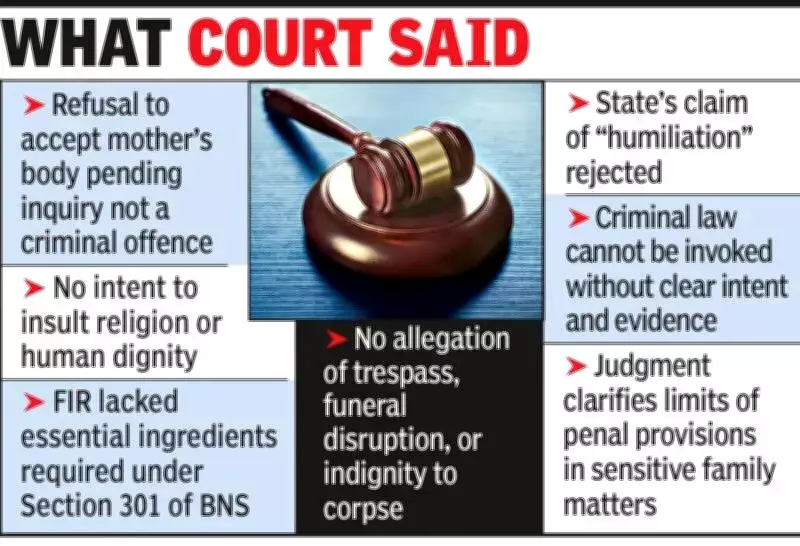
The Nagpur bench of the Bombay High Court has delivered a significant judgment by quashing a First Information Report (FIR) filed against a woman from Amravati. The woman was accused of insulting the dead after she refused to accept her mother's body pending an investigation into the circumstances of the death. The court ruled that this refusal does not attract criminal liability under Section 301 of the Bharatiya Nyaya Sanhita (BNS), 2023.
Court's Rationale and Legal Analysis
Justice Urmila Joshi-Phalke, while allowing the criminal application filed by Vijaya Ukarde through her counsel Shilpa Giratkar, held that the prosecution failed to establish even a prima facie case under the invoked provision. The FIR was registered at the Gadge Nagar police station in Amravati, alleging that the petitioner had humiliated her mother's body by declining to take custody after the death.
The incident occurred on October 13, 2025, when the woman's mother was found deceased at her residence in Amravati's Bhowate Layout. Police informed the petitioner and requested her to take possession of the body. However, she refused to accept the body until an inquiry was conducted into her mother's death, leading to the registration of the offence.

Arguments Presented by Both Sides
Counsel Shilpa Giratkar argued that Section 301 of the BNS applies only when there is a clear intention to wound religious feelings, insult religion, or cause indignity to a human corpse in a manner that affects public sentiments. She contended that a mere refusal to take custody of a body, especially when seeking clarification on the cause of death, cannot be construed as a criminal act.
In contrast, the state, represented by KR Lule, maintained that the petitioner's conduct amounted to humiliation of the corpse and justified prosecution. The state argued that the refusal itself constituted an indignity towards the deceased.
Court's Examination and Findings
Examining the FIR and material on record, Justice Joshi-Phalke noted that the only allegation was that the daughter was not ready to take possession of her mother's body. The judge emphasized that there was absolutely no whisper of any intent to insult religion or hurt sentiments in the FIR.
The court stated, "The FIR did not suggest any trespass into burial places, disturbance of funeral rites, or acts amounting to indignity towards the deceased." Explaining the scope of Section 301, the court clarified that the provision specifically requires elements such as deliberate intent to wound feelings, insult religion, or actions affecting funeral practices.
"None of the ingredients are fulfilled to attract the offence," the court held, adding that the allegations did not meet the statutory threshold for prosecution. The court underscored that criminal law must be applied with caution, particularly in cases involving personal grief and family decisions.
Implications of the Judgment
This ruling highlights the importance of intent in criminal cases under the BNS. It sets a precedent that mere refusal to accept a body, without evidence of malicious intent or public disturbance, does not constitute a criminal offence. The decision reinforces the need for careful application of legal provisions to avoid misuse in sensitive family matters.
The court's emphasis on caution in applying criminal law serves as a reminder to law enforcement agencies to thoroughly assess the elements of an offence before proceeding with prosecution. This judgment is expected to guide future cases involving similar circumstances under the Bharatiya Nyaya Sanhita.