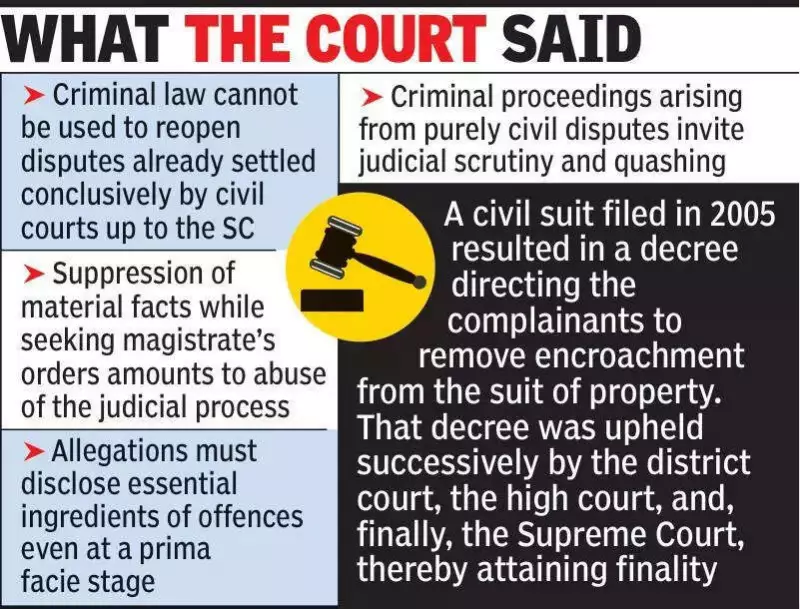
In a significant ruling, the Nagpur bench of the Bombay High Court last week quashed a criminal case against a businessman from Ramtek and imposed heavy costs of ₹50,000 on the complainants. The court strongly condemned the misuse of the legal system, stating that the prosecution was launched by hiding crucial facts, even though the underlying civil dispute had been conclusively settled by the Supreme Court nearly two decades ago.
Court Condemns Abuse of Legal Process
A division bench comprising Justices Urmila Joshi-Phalke and Nandesh Deshpande delivered the verdict while hearing a criminal application filed by businessman Omprakash Gawhane, represented by counsel AC Khare. The bench was scathing in its observation, labeling the case a clear abuse of the legal process. The judges held that criminal law was invoked with the ulterior motive of reopening issues that civil courts had decisively settled years ago.
The court set aside the entire criminal proceedings, which included a First Information Report (FIR) registered by Ramtek police in 2022, the subsequent chargesheet, and all related proceedings pending before the Judicial Magistrate First Class in Ramtek. The FIR had invoked several serious sections of the Indian Penal Code, including Sections 181, 182, 193, 424, 431, and 489, along with Section 3 of the Prevention of Damage to Public Property Act.

Background: A Long-Running Civil Dispute
The allegations in the FIR claimed that construction debris was dumped into a public well and on a road, and that false statements were made to public authorities. However, the High Court noted that these allegations originated from a protracted civil dispute over alleged encroachment. The judges pointed out a critical lapse: the complainants had suppressed the material fact that the issue of encroachment had already been decided against them in earlier civil proceedings, which had reached finality up to the Supreme Court.
Despite this settled civil matter, the complainants initiated further civil suits and, while an appeal was pending, approached a magistrate seeking a criminal investigation under Section 156(3) of the Criminal Procedure Code. The High Court observed that the police then "mechanically registered" the FIR based on the magistrate's direction without proper scrutiny.
Vague Allegations and Legal Principles
Upon examining the complaint and the evidence collected during the probe, the bench found the allegations to be vague and lacking the essential ingredients of the offences cited. The court held that none of the invoked IPC sections were made out, even on a prima facie reading of the case.
The ruling emphasized that the case squarely fell within the principles established by the Supreme Court in the landmark Bhajanlal judgment. This precedent allows for the quashing of criminal proceedings that are "manifestly attended with mala fide" or instituted with an ulterior motive for wreaking vengeance. By imposing costs of ₹50,000 on the complainants, the Nagpur bench sent a strong message against the misuse of criminal machinery to harass individuals after the conclusion of civil litigation.
This judgment reinforces the judiciary's role in preventing the weaponization of criminal law to settle personal scores or revisit conclusively decided civil matters, thereby protecting citizens from frivolous and vexatious litigation.