
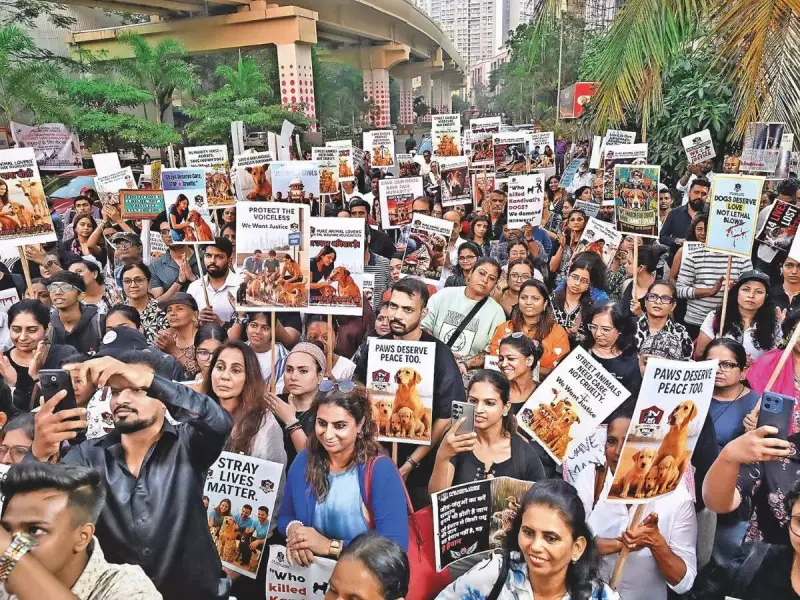
On Sunday, the streets of Mumbai witnessed a significant outpouring of public sentiment as residents from diverse backgrounds gathered to voice their strong opposition to a recent Supreme Court directive. The order, which mandates the mass removal and sheltering of stray dogs, has sparked nationwide concern, with the next hearing in the case set for January 7.
Nationwide Outcry Reaches Mumbai Streets
Mirroring similar demonstrations across India, animal caregivers and rights activists in Mumbai assembled in large numbers, labeling the court's order as inhumane. They called for the adoption of more compassionate and sustainable animal welfare strategies instead. The protests in the financial capital were notably held in the suburbs of Andheri and Bandra.
Participants, representing various animal rights non-governmental organizations, carried placards and chanted slogans to make their stance clear. A powerful chant that resonated through the crowds was "Awara nahi, hamara hai" (They are not stray, they are ours), emphasizing the community's sense of ownership and responsibility towards street dogs.
Legal Focus and Peaceful Demands
Advocate Arbaaz Waris Pathan, the legal representative and spokesperson for the animal welfare group Rakshak, clarified the intent behind the mobilization. He stated that the protest was a peaceful expression driven by love for animals and societal concern. Their core demands are compassion, accountability, and lawful treatment for street dogs.
Outlining the future strategy, Advocate Pathan emphasized legal awareness. "Our focus now is legal awareness. We want feeders and citizens to know their rights and follow lawful ways to protect animals, because violence or illegality will only weaken the cause," he explained. This approach underscores a commitment to working within the legal framework to advocate for change.
A Voice for the Voiceless
Protestors also held a silent march along Linking Road in Bandra, carrying emotional placards. Mohini Srivastava, associated with an animal NGO, articulated the sentiment of many present. "We are here to protect the strays and be their voice. These animals have been a part of our society for years. They are cared for by local communities and deserve compassion, not confinement," she said.
The protest succeeded in drawing attention from beyond the usual circles of animal lovers. Aditi Parameshwaran, who runs an animal shelter in Dombivli, highlighted this unifying aspect. "People from across the city came together, including many who don’t even have pets. This march helped us reach hundreds of people who may not have known what was happening to street dogs, and that awareness was one of the biggest outcomes of the protest," she noted.
Parameshwaran also pointed to a critical gap in policy-making, urging authorities to consult with those who have hands-on experience. "Before making policies about removing and housing dogs, the authorities need to speak to people who actually run shelters. It takes far more than just space and walls — there is no planning for costs, manpower or the realities of long-term care," she asserted. The protestors collectively urged all citizens to become advocates for street dogs, pushing for policies grounded in reality and empathy.