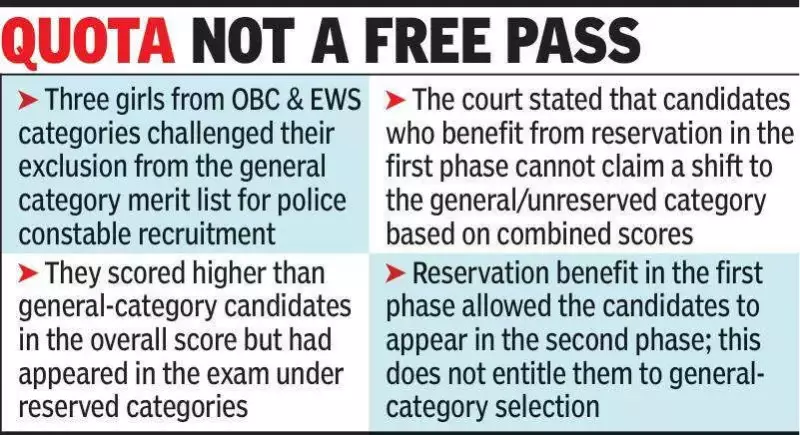
In a significant legal development concerning recruitment rules and reservation policies, the Madhya Pradesh High Court has dismissed a petition filed by three female candidates belonging to the Other Backward Classes (OBC) and Economically Weaker Sections (EWS) categories. The candidates had sought their selection for the post of police constable under the general category, arguing their overall scores surpassed the general category cut-off.
The Core of the Controversy
The three petitioners had appeared for a state police constable recruitment examination. They had applied and taken the initial written test under the OBC and EWS reserved categories. In this first phase, their scores, while sufficient to clear the lower cut-off for their respective reserved categories, were below the higher cut-off mark set for the general (unreserved) category candidates.
However, the scenario changed in the subsequent Physical Proficiency Test (PPT). The girls performed exceptionally well in the physical round. Their high scores in the PPT, when combined with their written test marks, resulted in an overall aggregate that exceeded the final cut-off required for selection in the general category.

Court's Rationale and Dismissal
Despite their overall score, their names were not included in the merit list for the general category. The authorities maintained that since they had cleared the first hurdle (the written test) only by availing the benefit of the lower cut-off for OBC/EWS categories, they could not later be adjusted against general category seats.
The single-judge bench of Justice Deepak Khot heard the petition challenging the final merit list. In his ruling, Justice Khot upheld the recruitment authorities' stance. The court elaborated that the petitioners were given a chance to appear in the second phase (PPT) solely because they qualified in the first phase under the reserved category with its relaxed cut-off.
"As per Rule, though the petitioner(s) did not secure more marks than the cut-off marks of the unreserved category for the first phase, (they) were given a chance to appear in the second Physical Proficiency Test by granting benefit of the OBC reserved category," the court observed.
The judgment further stated that there was no question of considering their total marks for selection in the general category by applying the principle of adjusting a reserved category candidate against an unreserved seat. The court pointed out that if this principle were applied, the very benefit of OBC reservation that allowed them to proceed to the second phase would become irrelevant, and their candidature would have been rejected after the written test itself.
Implications and Final Outcome
This ruling underscores a fundamental principle in public recruitment: the category under which a candidate applies and clears the initial qualifying stage is binding for the entire selection process. Candidates cannot switch categories mid-stream based on their performance in later stages, even if their final aggregate meets a different category's standard.
By dismissing the plea, the Madhya Pradesh High Court has reinforced the existing framework governing reserved category recruitment. The judgment clarifies that the benefit of a lower cut-off in the preliminary stage comes with the condition of being considered only for seats earmarked for that specific category in the final merit list, preventing any ambiguity in future recruitment drives for police and other government posts.