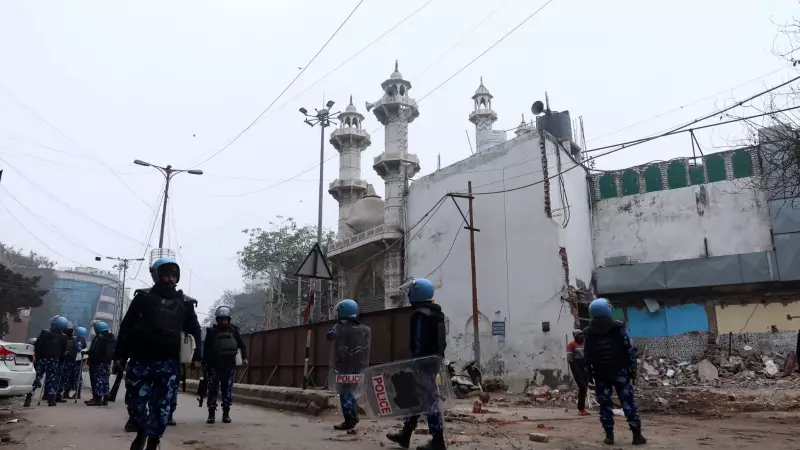
Fresh tensions erupted in central Delhi's Turkman Gate area early on Wednesday, January 7, 2026, as a demolition drive by the Municipal Corporation of Delhi (MCD) near the historic Masjid & Dargah Syed Faiz-e-Ilahi led to a violent confrontation. Local residents reportedly pelted stones at officials, prompting police to respond with mild tear gas to disperse the crowd. The civic action resulted in the registration of a First Information Report (FIR) and the arrest of five individuals.
The Legal Backdrop and Court's Verdict
The demolition was executed just hours after the Delhi High Court declined to grant an interim stay on the proposed MCD action. This legal green light followed a protracted dispute over land use and encroachments in the vicinity of the mosque, which is located near the iconic Ramlila Maidan.
The sequence of events leading to the demolition began in May 2025, when an organization named the Save India Foundation filed a complaint with government authorities. The complaint alleged that a large mosque/markaz structure, a banquet hall, a charitable dialysis center, and several commercial pathology labs were operating illegally on government land. The foundation's founder, Preet Singh, stated the group works on enforcing citizens' rights.
Acting on this complaint, a joint survey was conducted on October 16, 2025, by officials from the Land and Development Office (L&DO), Delhi Development Authority (DDA), and the MCD. The survey findings were significant: it confirmed roughly 2,512 square feet of encroachment on the road and footpath maintained by the Delhi PWD, and a further 36,248 square feet of encroachment on the adjoining Ramlila ground.
The Heart of the Dispute: 0.195 Acres of Land
Armed with the joint survey report, the Save India Foundation approached the High Court. On November 12, 2025, the court directed the MCD to take "appropriate action for removal of such encroachment" on land under its jurisdiction and conclude it expeditiously.
The managing committee of the Masjid & Dargah Syed Faiz-e-Ilahi, constituted by the Delhi Waqf Board, has consistently claimed that the mosque, dargah, and an adjacent Muslim graveyard were established as Waqf property over a century ago. They contend that the open ground, used for community activities like medical camps and ration distribution, is part of this Waqf land.
However, the MCD, in an order dated December 22, 2025, asserted that "by no stretch of imagination" can a mosque or dargah be used as a marriage venue or clinic, calling it a "blatant misuse of public land." The civic body declared that any structure beyond 0.195 acres of land is an encroachment and must be removed.
This specific measurement—0.195 acres—lies at the core of the conflict. It originates from a lease deed dated February 1940. While government authorities have assured they will not touch this demarcated area, stating it encompasses both the mosque and the graveyard, the Masjid committee argues the graveyard lies outside this limited parcel.
Security Concerns and Historical Context
Adding urgency to the government's move, the Public Works Department (PWD) had highlighted the "critical importance" of Asaf Ali Road, where the mosque is situated. In a notice, the PWD described the road as a high-priority carriageway crucial for VVIP and emergency security movements, stating that obstructions could impede national security and city mobility.
The Faiz-e-Ilahi mosque had also been in the news recently for a different, grim reason. In November 2025, CCTV footage revealed that Umar Nabi, the main accused in the Red Fort blast case, had visited the mosque for 15 minutes before driving the car that later exploded at a traffic signal.
The Delhi Waqf Board, in an October 2025 note, acknowledged complaints about the misuse of this Waqf property dating back to the year 2000. The Board cited a 1970 gazette notification that listed two Waqf properties at the site. While one, the "Khawaja Faiz Elahi Mosque alias Mosque Ghosian and Graveyard," was confirmed, the notification did not specify its exact measurements, creating the legal grey area now being contested.
The demolition drive and subsequent violence underscore the complex interplay of urban encroachment, historical land rights, and community sentiment in the heart of India's capital. With legal avenues pursued and tensions simmering, the resolution of the 0.195-acre dispute remains a closely watched issue.