Senior Maoist Leader Nikhil Surrenders in Odisha, Appeals for Peaceful Path
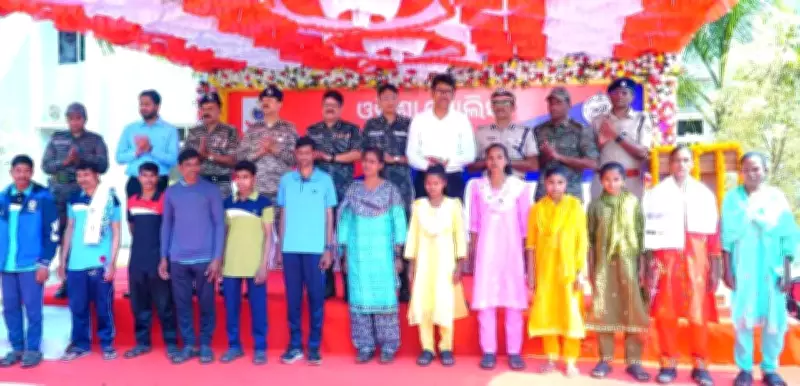
In a significant development in the fight against Left Wing Extremism, senior CPI (Maoist) leader Niranjan Rout, widely known as Nikhil, formally surrendered before police authorities in Rayagada, Odisha, on Saturday. During the surrender ceremony, Nikhil made a heartfelt appeal to his former comrades still operating underground to abandon violence and reintegrate into mainstream society through democratic means.
Video Message Calls for Democratic Struggle
Following his surrender, Nikhil released a video message where he expressed disillusionment with the armed movement. He stated that the "armed struggle" had lost its direction and was increasingly disconnected from the very people it purported to represent. "Today, it is very difficult to continue with an armed revolution. We are losing a lot and moving away from the masses," Nikhil declared in the video.
He explained that he, along with his wife Rasmita Lenka alias Indu and another cadre named Bikash, chose to surrender to continue their fight for the downtrodden through constitutional channels. "Leave the gun, come to the mainstream and work for society in a democratic manner," he urged fellow Maoists. Nikhil provided a police contact number, 9437643839, and assured potential surrenderees of full assistance under the government's rehabilitation policy.

High-Profile Surrender with Substantial Bounties
The surrender event was notable for the seniority of the individuals involved. Nikhil, aged 47, and his wife Indu, aged 43, were both members of the CPI (Maoist) Odisha state committee. They surrendered alongside a divisional committee member, five area committee members, and seven additional party members, bringing the total to 16 individuals.
Each of the couple carried a reward of Rs 55 lakh, and the cumulative bounty on all the surrendered Maoists, which included seven women cadres, amounted to an impressive Rs 1.98 crore. This underscores their high-value status within the Maoist hierarchy and the significant blow their surrender deals to the organization's operations in the region.
Backgrounds of the Surrendered Leaders
Nikhil's journey into radical politics began in the aftermath of the devastating 1999 Super Cyclone that hit Odisha's coastal belt. Hailing from Tentulibelari village in Jagatsinghpur district, he was drawn to Left-wing activism during NGO-led rehabilitation efforts. By 2005, after receiving training in West Bengal and Sambalpur, he was formally inducted into the Maoist outfit.
Over the years, Nikhil rose through the ranks to become the secretary of the Bansadhara-Ghumusar-Niyamgiri (BGN) division. Known for his secretive and strategic acumen, he handled critical responsibilities such as party literature, press statements, and major review meetings. Police officials noted that he played a key role in sustaining the Maoist network in Odisha during periods when senior leadership was absent.
His wife, Indu, originated from Rasikanagar village in Cuttack district. A college graduate, she joined the Maoist movement in 2004 while pursuing her post-graduation, influenced by activists from the Chhatra Yuba Sangram Committee. She severed all contact with her family upon joining. "We joined with a vision to eliminate the exploitation of the downtrodden in society. But we couldn't achieve that goal. Now it is the call of the time to change and fight in a democratic and constitutional way," Indu stated after her surrender.
Police reports indicate that Indu was actively involved in logistical operations, including collecting funds from local contractors in Kalahandi and Rayagada districts and arranging essential supplies like rations and medicines through sympathizers.
Police Assessment and Regional Impact
Additional Director General (anti-Naxal operations) Sanjeeb Panda provided insights into the couple's influence. He stated that Nikhil and Indu exercised strong control over remote areas in Kandhamal, Kalahandi, and Rayagada districts, regions characterized by poor communication facilities. However, Panda attributed their surrender to the steady decline of CPI (Maoist) influence and sustained pressure from security forces, which forced them to reconsider their path.

With this high-profile surrender, police authorities are optimistic about a significant weakening of Maoist operations in the BGN region. There is a strong expectation that Rayagada district may soon be declared Maoist-free, marking a pivotal achievement in the state's efforts to curb Left Wing Extremism and restore normalcy in affected tribal hinterlands.