In a decisive move to tackle chronic traffic congestion during large gatherings, Lucknow Police Commissioner Amrendra Sengar has issued a mandatory order for all event organisers. The directive, announced on Friday, requires them to deploy adequate traffic marshals at approach roads and parking areas as a non-negotiable condition for obtaining permission.
Strict Compliance and Enhanced Enforcement
The police chief made it clear that any failure to comply with this rule will result in the denial or outright cancellation of event permissions. To bolster enforcement capabilities, the traffic police have been instructed to deploy 10 additional racer mobile units and 42 extra sub-inspectors.
This order was formulated during a high-level review meeting on Friday, attended by senior officials including JCP Law and Order Babloo Kumar, JCP Crime Amit Verma, DCP West Vishwajeet Srivastava, DCP East Shashank Singh, and DCP Traffic Kamlesh Dixit. The meeting was convened to assess traffic management during the recent New Year celebrations, which revealed significant challenges.

Unprecedented Pressure from Pilgrim Rush and Melas
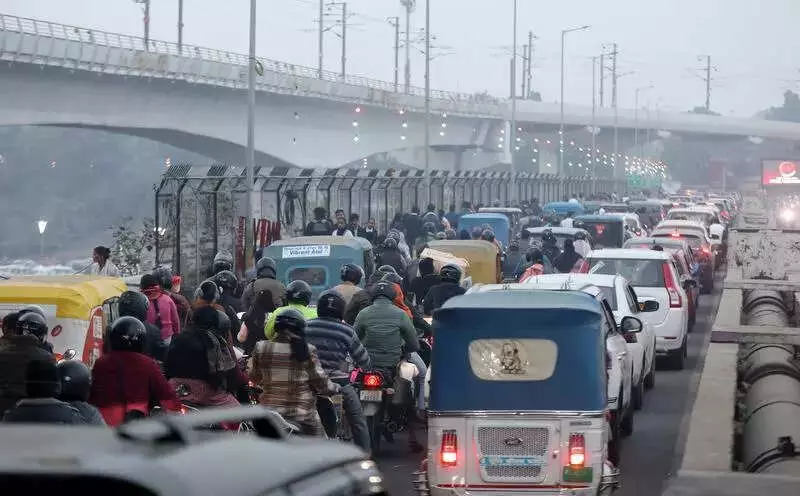
The review highlighted an unprecedented vehicular pressure across the city on January 1st. This was primarily driven by a massive influx of pilgrims to four major temples: Hanuman Setu, Khatushyam Temple, Mankameshwar Temple, and Hanumant Dham. Police estimates indicate that over 5 lakh devotees visited these temples, generating nearly 1 lakh vehicle movements within a confined urban area.
The situation was exacerbated by the simultaneous organisation of Katki Mela and Uttarayani Mela along the same key traffic corridors. Locations like Parivartan Chowk and Nadwa Bandha Mod, situated in densely populated zones with limited road width, were particularly affected. While advance planning and large-scale police deployment prevented a complete gridlock, Commissioner Sengar identified unauthorised parking and poor crowd management at venues as major contributors to congestion.
New Traffic Management Protocols
Moving forward, no event will receive permission unless organisers submit a detailed traffic management plan. This plan must include the deployment of trained traffic marshals at entry points, approach roads, and parking zones. Organisers will be held directly accountable for ensuring smooth vehicular movement around their venues, especially during peak hours.
To tackle the persistent issue of illegal parking, the Commissioner ordered an expansion of crane and towing operations. New traffic-prone stretches will be identified where vehicles parked on carriageways and intersections create bottlenecks, and continuous towing action will be enforced there.
The meeting also stressed the need for better coordination with the Lucknow Development Authority (LDA), Public Works Department (PWD), and municipal authorities. The goal is to address road engineering flaws and improve signage, lane markings, and parking infrastructure. Police have been told to prepare time-bound, event-specific traffic diversion plans.
Looking ahead, officials were instructed to conduct advance inspections of the upcoming Green Corridor Road in coordination with LDA and PWD. This proactive measure aims to identify potential traffic challenges before the road becomes operational, preventing congestion from spilling onto connecting routes.
Finally, the Police Commissioner emphasised improving public awareness. Traffic advisories, parking details, diversion maps, and alternative routes for major events must be widely publicised through print and social media at least four days in advance. Given Lucknow's status as the state capital and its frequent high-profile events, a proposal for additional police personnel has been moved to ensure robust traffic management in the coming months.