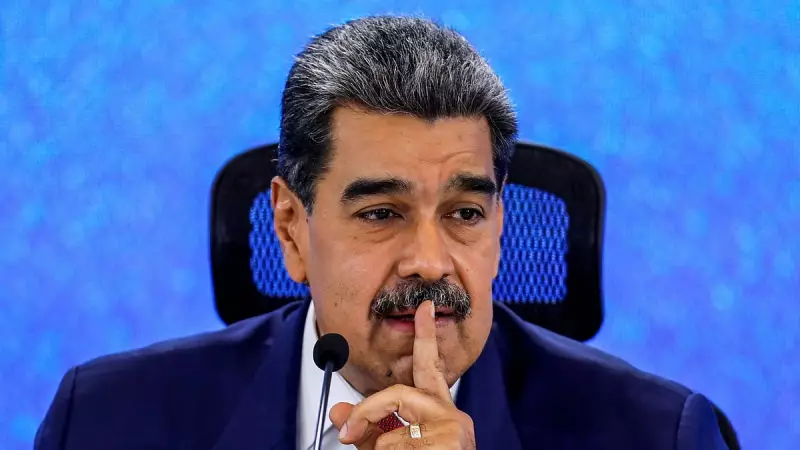
The recent announcement by the United States government, offering a multi-million dollar bounty for information leading to the capture of Venezuela's sitting President Nicolás Maduro, has ignited a fierce global debate. The core question is stark: Was the proposed US capture of Venezuela's president legal under international law? This move, tied to drug trafficking and narco-terrorism charges, pushes the boundaries of legal norms and sovereign immunity.
The US Charges and the Bounty Offer
In March 2020, the US Department of Justice unsealed indictments against President Nicolás Maduro and several other senior Venezuelan officials. The charges were severe, including narco-terrorism conspiracy, corruption, and drug trafficking. The US alleges that Maduro and his associates conspired with Colombian rebel group FARC to flood the United States with cocaine.
Concurrently, the US State Department announced staggering bounties: $15 million for information leading to Maduro's arrest and/or conviction, and $10 million each for several other officials. This placed a formal price on the head of a sitting head of state with whom the US does not maintain diplomatic relations.
The Legal Minefield: Sovereignty and Immunity
Legal scholars point to several formidable obstacles that make the actual capture of President Maduro highly problematic under international law. The principle of sovereign equality of states is a cornerstone of the international system. One state cannot simply exercise its police power within the territory of another without consent, which Venezuela would never grant.
Furthermore, the doctrine of head of state immunity offers strong protection. A sitting head of state generally enjoys immunity from the jurisdiction of foreign national courts for both official and private acts. This immunity is considered functional, allowing them to govern without fear of foreign litigation or arrest. While there are exceptions for international crimes like genocide or war crimes before international tribunals, the US charges, though serious, are under its own domestic law.
"The US attempt to arrest a sitting head of state of another country is a clear violation of international law," argues many experts. It would be seen as a direct assault on Venezuela's sovereignty and could be interpreted as an act of aggression.
Possible Scenarios and Precedents
How could such a capture theoretically occur? Analysts outline a few high-risk, low-probability scenarios:
- Extradition from a Third Country: If Maduro were to travel abroad to a country friendly to the US, he could potentially be arrested and extradited. However, aware of this risk, he has drastically limited his international travel.
- Internal Overthrow: The US bounty could incentivize a internal coup. If Maduro were deposed and a new, US-friendly government took power, they might hand him over. This was the precedent set with Panama's Manuel Noriega in 1989.
- Military Intervention: A direct US military operation on Venezuelan soil to extract him. This would be an extreme act of war with massive geopolitical repercussions and is widely considered unlikely.
The 1989 US invasion of Panama to capture Manuel Noriega is often cited, but it remains a controversial precedent, not an accepted legal norm. The International Court of Justice (ICJ) has historically upheld head of state immunity, as seen in cases against leaders from Congo to Sudan.
Political Objectives vs. Legal Reality
Many observers believe the primary aim of the indictments and bounties is political rather than a realistic law enforcement operation. The goals are multifaceted: to delegitimize Maduro's regime internationally, to encourage defections and instability within his inner circle, and to maintain maximum pressure as part of a broader sanctions strategy.
By framing Maduro as a narcotics kingpin, the US justifies its comprehensive economic sanctions and rallies regional and domestic support for its policy of regime change in Venezuela. The legal maneuver is a powerful tool in this political campaign, even if the prospect of a trial in a New York courtroom remains remote.
The Venezuelan government has vehemently denounced the US actions as illegal and a form of "lawfare"—using legal instruments as weapons of war. They view it as another chapter in a long history of US interventionism in Latin America.
In conclusion, while the US has laid out serious criminal charges, the path to legally capturing a sitting president under international law is effectively blocked by principles of sovereignty and immunity. The move stands as a potent political symbol, escalating tensions and highlighting the use of domestic legal systems as instruments of geopolitical conflict, creating a complex dilemma at the intersection of law, politics, and state power.