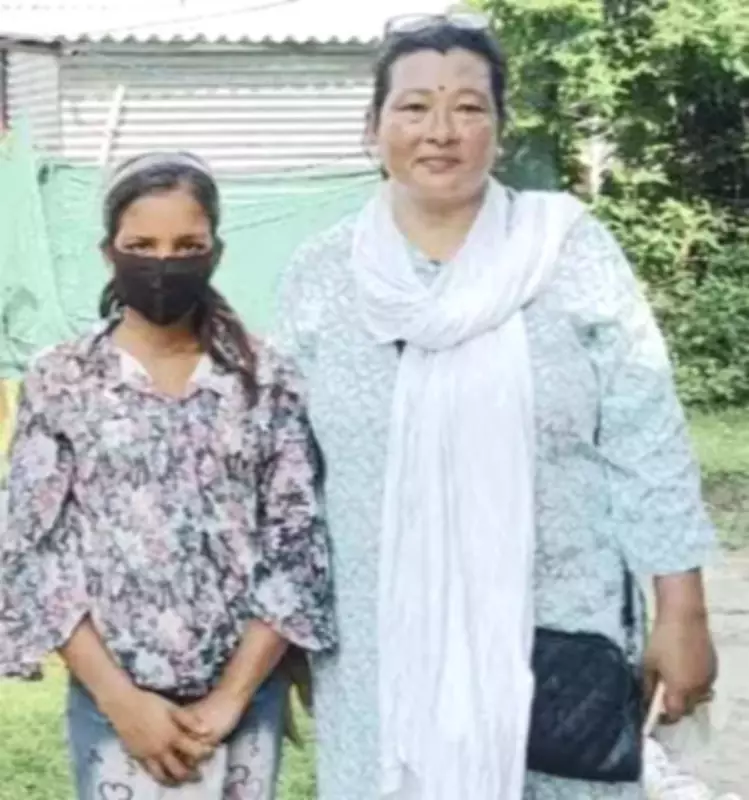
Three Decades of Courage: Lakshmi Khatri's Lifelong Battle Against Human Trafficking
In the vulnerable borderlands between India and Nepal, where poverty and open frontiers create fertile ground for exploitation, one woman has stood as an unwavering shield for three decades. Lakshmi Khatri, 46, a resident of Bagaha in West Champaran, Bihar, has dedicated her life to preventing human trafficking, personally rescuing more than 700 girls and young women from criminal networks operating across the region.
Building an Informal Vigilance Network
Khatri has constructed a remarkable informal vigilance system that connects villagers with multiple authorities, including the police, Railway Protection Force (RPF), Sashastra Seema Bal (SSB), child welfare committees, and various social organizations. This grassroots network has become a critical early-warning mechanism in an area where trafficking often goes unnoticed.
"I am originally from Nepal's Nawalparasi district, but I was married in Bettiah in West Champaran, Bihar," Khatri explained. "Even as a student, I began hearing frequent reports of girls going missing from my village and nearby areas, which pushed me to start investigating on my own."

From Student Concern to Lifelong Mission
Khatri began her anti-trafficking work in 1994 in Nepal after recognizing a disturbing pattern of disappearances from villages in the Terai belt. Many victims were lured with false promises of employment or marriage to distant cities.
"During this time, I joined an organization in Nepal that works against human trafficking," she recalled. "After joining, I realized that most girls were being lured with false promises of jobs and trafficked to major cities like Mumbai, Delhi, Bengaluru, and parts of West Bengal through the open India-Nepal border."
Strategic Positioning Along Vulnerable Borders
After her marriage brought her to West Champaran, Khatri continued her mission with renewed determination. She identified specific high-risk areas along the porous frontier.
"Areas such as Valmikinagar, Bhikhnathori, and Bhiswa, which lie along the open border, are considered safe routes by traffickers for transporting girls," Khatri noted. "This is why I started living in Valmikinagar on the India-Nepal border in 2000 and later moved to Bagaha to continue my work with an organization of Bihar."
She has now been fighting trafficking in West Champaran for 25 years, becoming a trusted figure in border communities.
Recent Successes and Official Recognition
On January 23 this year, Khatri's network proved its effectiveness once again. A villager from Naurangiya under Bagaha-2 block reported suspicious activity involving a new family taking three minor girls with them.
"I immediately informed the police," Khatri said. "The investigation revealed that a mother and son from West Bengal were luring the three minor girls to West Bengal under the pretext of providing them with good jobs."
Bagaha SP Ramanand Kaushal confirmed that Khatri's inputs have been critical in several cases. Regarding the January 23 incident, he stated: "Three minor girls were saved and two smugglers arrested."
Civilian Partnership with Border Forces
Commandant of SSB's 65 battalion, Nandan Singh Mehra, praised Khatri's contributions to border security. "She has been a strong civilian partner in border-area vigilance," he said. "Her awareness campaigns have significantly improved reporting of suspicious movements."
Mehra added that with Khatri's support, 15 traffickers were arrested in recent weeks alone, demonstrating the tangible impact of her work.
Community Transformation and Trust
Local resident Sudhir Kumar of Valmikinagar described how Khatri has changed community perspectives. "In a region where poverty, migration, and open borders make human trafficking easy and invisible, Lakshmi Khatri has become a living shield," he said.
"We often dismissed trafficking as regular migration for work. Now, if we suspect any wrongdoing, we first inform Khatri Didi," Kumar added, using the affectionate term for "elder sister."

Khatri's approach is notable for what she lacks as much as what she possesses. Not armed with power or position, but with trust, persistence, and compassion, she continues her quiet war against one of the most brutal crimes in the borderlands. Her work demonstrates how individual courage, when combined with community engagement and official cooperation, can create meaningful protection for the most vulnerable.