Kolkata Student's Exam Preparations Shattered by Late-Night Gang Violence
As the Madhyamik examinations commenced on Monday across West Bengal, fifteen-year-old Snigdha Haldar, a dedicated Class 10 student at Kamala Girls' School, found her crucial last-minute revision brutally interrupted. The evening before her exams, around 8:30 PM on Sunday, Snigdha was immersed in her studies when terrifying screams pierced the air outside her home on Panchannatala Road near Golpark.
Panic and Trauma in Exam Season
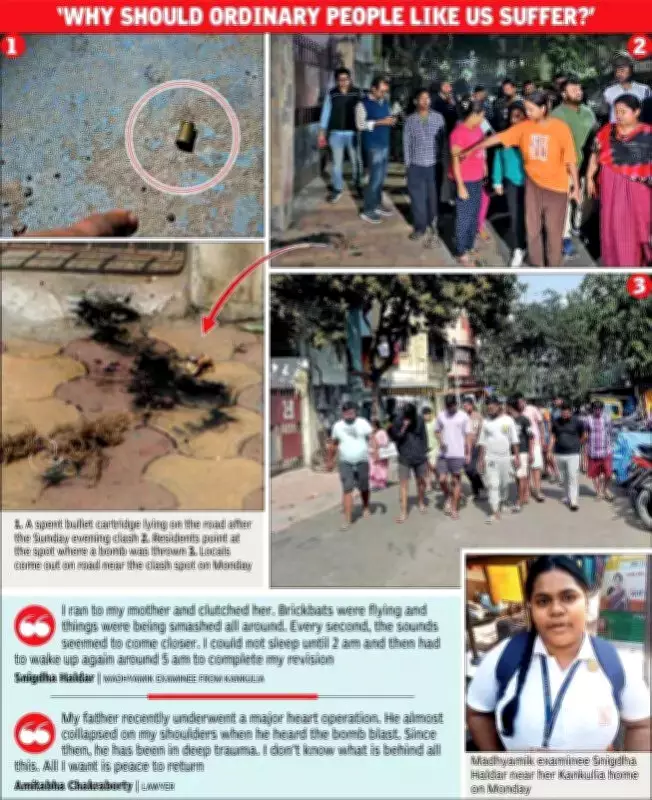
"I was just going to alert my mother when the deafening blast of a country-made bomb sent me into complete panic," recounted Snigdha, her voice still trembling with residual fear. Her mother, Purnima, had been preparing dinner in their kitchen when the violence erupted unexpectedly. "I ran to my mother and clutched her tightly. Brickbats were flying everywhere, and things were being smashed all around us. Every second, the terrifying sounds seemed to come closer," she described vividly.
The traumatic experience left such deep psychological scars that Snigdha could not find sleep until 2 AM, despite facing critical board examinations mere hours later. "I had to force myself awake again around 5 AM to complete whatever revision I could manage," she added, highlighting how ordinary academic pressures were compounded by extraordinary violence.
Residents Describe Coordinated Attack
Nearly nineteen hours after the violent clash, visible damage remained along Panchannatala Road and in the Kankulia area. Residents identified the perpetrators as members of the Kasba-Tiljala syndicate, allegedly led by local strongman Sona Pappu. The attack reportedly targeted promoter Bapi Haldar, whose office stands close to the affected residential buildings.
Lawyer Amitabha Chakraborty, a resident of the Benubon Cooperative Society opposite Snigdha's home, shared his family's parallel trauma. "My father recently underwent major heart surgery. When he heard the bomb blast, he almost collapsed on my shoulders. Since that moment, he has been in deep psychological trauma," Chakraborty revealed emotionally. "I don't understand what drives such violence. All we ordinary residents want is for peace to return to our neighborhood."
Pattern of Violence Emerges
Local accounts suggest this represents the third attack by the Sona Pappu gang in the area since the COVID-19 pandemic began. Rajesh Das, a hawker at nearby Gariahat Market, provided historical context: "The first incident involved minor threats and slaps nearly two years ago. Another attack occurred during Ganesh Puja last year under similar circumstances, though with fewer attackers."
Das expressed profound frustration about the collateral damage affecting innocent bystanders. "Why should someone travel all the way from Kasba to create trouble here? My own son was barely meters from where the first bomb was hurled. Why must ordinary families suffer because of territorial wars between promoter gangs?" he questioned angrily.
Elderly Residents Trapped in Homes
A sixty-six-year-old resident of adjoining Krishnakunja Apartment described particularly frightening circumstances. Friends had gathered to welcome her home after a three-day hospital stay when violence suddenly erupted. "From my third-floor flat, I could see tremendous commotion downstairs. Initially, I thought local residents were celebrating since about 150 neighbors had gone on a picnic," she recalled.
The reality became terrifyingly clear when explosions rocked the building. "When the bomb detonated, all the glass panes in my flat shook violently—something completely unusual for ordinary firecrackers. Only thirty minutes later did we realize this was a coordinated attack. Everyone who came to visit me became trapped inside, and we spent hours in anxious uncertainty," said the senior citizen, who requested anonymity for safety reasons.
Community Response and Police Expectations
As violence unfolded, residents of local housing societies took immediate protective measures, shutting main gates and barricading entrances. Members of the Benubon Cooperative Society even contacted residents of the nearby Kankulia slum—many of whom work in the apartment complex—to gather real-time information about the attack's progression.
Amrita Mukherjee, a resident of a nearby standalone flat, emphasized the neighborhood's generally peaceful character. "We moved here in 1994, and the area has always been tranquil. We maintain cordial relationships with slum residents who work among us. These sudden attacks have left every family shaken to the core. We desperately hope Kolkata Police will take adequate, decisive action to prevent recurrence," she stated firmly.
The incident highlights how gang violence between promoter syndicates increasingly disrupts civilian life in Kolkata, affecting students during critical academic periods, endangering elderly residents, and traumatizing entire communities caught in crossfire.