Kolkata Crime Kingpin Sona Pappu Evades Police After Kankulia Violence
The alleged mastermind behind the recent Kankulia violence in Kolkata, Biswajit Poddar alias Sona Pappu, has successfully managed to evade police capture, raising serious questions about law enforcement effectiveness in the city. For Kolkata police, Pappu represents a familiar and frustrating challenge - a career criminal who has repeatedly slipped through their net despite a long history of serious offenses.
A Criminal Career Built on Political Patronage
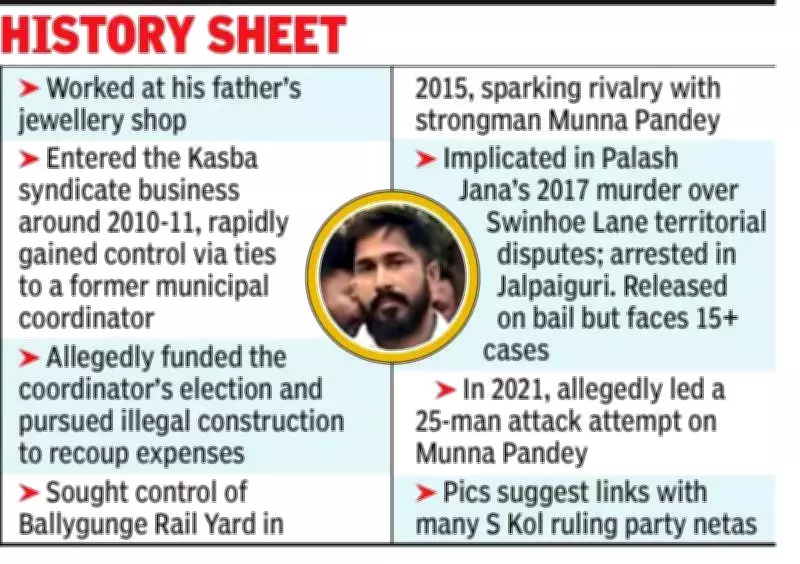
Pappu's criminal journey began when he entered the construction business around 2010-2011, marking the start of his frequent stints in and out of jail. From the very inception of his operations in Ward 67, Pappu strategically cultivated political connections that provided him with protection and access to power. This patronage became particularly evident in 2017 when, after committing a murder at Bediadanga, he boldly told a police officer: "Don't try to catch me. You don't know my connections."
From Jewellery Shop to Syndicate Control
The origins of his nickname Sona Pappu trace back to his early days working at his father's jewellery shop in Picnic Garden. However, he soon transitioned to more lucrative and dangerous ventures, establishing himself in the syndicate business in Kasba. According to a former officer who arrested him twice, Pappu quickly gained control over the area through his close association with a former municipal coordinator.
"Pappu claimed he spent substantial money to ensure the coordinator's electoral victory, which subsequently pushed him into illegal construction activities to recover those funds," revealed the former officer, highlighting the corrupt nexus between crime and politics.
Violent Territorial Disputes and Multiple Charges
Pappu's criminal ambitions expanded in 2015 when he attempted to control the Ballygunge Rail Yard, bringing him into direct conflict with another notorious strongman, Munna Pandey. This rivalry turned deadly in 2017 with the murder of Palash Jana over territorial disputes on Swinhoe Lane. Although Pappu was eventually arrested in Jalpaiguri and released on bail, police records indicate he still faces at least 15 serious charges, including:
- Attempted murder
- Rape
- Multiple violations under the Arms Act
His rival Munna Pandey has also served time for various offenses, with tensions escalating in 2021 when an attempt was made to attack Munna outside Presidency Jail with 25 associates.
Political Connections Surface During Investigations
During Pappu's most recent arrest, investigators uncovered photographic evidence linking him to leaders of the ruling party, raising uncomfortable questions about political-criminal relationships. Rashbehari MLA and MMiC Debashis Kumar responded to these revelations by stating: "If someone commits a crime, regardless of who they are, cops will arrest them. I also demand his arrest. There might be several pictures of me with him because I am a public representative."
Kumar further defended himself by drawing a parallel: "Even the Prime Minister has pictures with Nirav Modi and Mehul Choksi. Does that mean we should hold the PM responsible for the allegations against Nirav Modi?"
Public Representatives Defend Their Associations
Ward 91 councillor and MMiC Baiswanor Chatterjee faced similar scrutiny for attending the rice ceremony of Pappu's daughter. He explained his position: "As a public representative, I would often be photographed with many people without knowing their criminal records. I taught in a college and practised law for over three decades. Do not try to frame me."
Echoing Kumar's defense, Chatterjee questioned: "Do photos with Nirav Modi make PM Narendra Modi an accused?" These statements highlight the complex challenge of distinguishing between legitimate public engagement and problematic associations with criminal elements.
The ongoing evasion of Sona Pappu underscores deeper systemic issues in Kolkata's law enforcement and political landscape, where criminal elements continue to operate with apparent impunity, protected by networks of influence that extend into the highest levels of local governance.