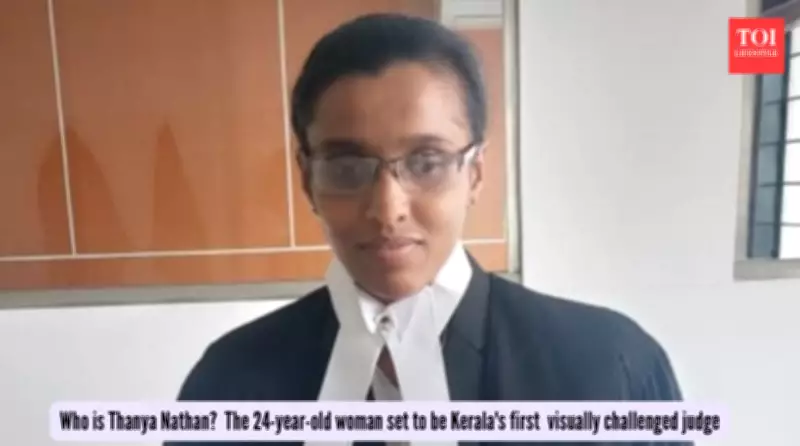
Thanya Nathan Creates History as Kerala's First Visually Impaired Woman Judge
In a landmark moment for judicial inclusion in India, Kerala is witnessing a transformative shift in its legal landscape. Thanya Nathan C, a determined 24-year-old lawyer from Kannur district, has shattered long-standing barriers to become the state's first visually challenged woman judge. Her remarkable achievement stands as a powerful testament to resilience and progress in a system where tradition has often dictated limitations.
Breaking Barriers Through Determination
According to detailed reports from NDTV, Nathan secured the top position on the merit list for candidates with benchmark disabilities in the recent Kerala High Court Civil Judge (Junior Division) examination. While Joyson Sajan claimed the second spot, Nathan's accomplishment resonates particularly strongly as a beacon of hope for greater diversity within India's judicial framework.
Blind since birth, Nathan's educational journey began in Mangad, Kerala, where she attended a special school in Dharmadom through Class 10. She continued her studies at Parassinikadavu High School and later at Morazha Government Higher Secondary School. It was during these formative years that she discovered her passion for law, setting her on an extraordinary path.

Academic Excellence and Professional Preparation
As reported by PTI, Nathan pursued her legal education with exceptional dedication at Kannur University, where she not only completed her LLB program but emerged as the top-performing student—the only visually impaired individual in her cohort. Following graduation, she gained practical experience working as a junior lawyer in Taliparamba for one year, developing innovative methods to navigate her profession.
Her preparation involved creating argument notes in Braille and utilizing advanced screen-reading software to manage her legal practice effectively. For the judicial examination, Nathan adopted a self-driven study approach relying on Braille materials, supplemented by guidance from a lawyer based in Thiruvananthapuram for interview preparation.
Navigating Challenges with Technological Support
In her conversation with PTI, Nathan expressed both confidence and realism about the road ahead. "I recognize this will be a demanding career path," she acknowledged. "However, technological advancements have reached a point where most judicial responsibilities can be managed using assistive tools like screen readers and dictation software."
She also highlighted existing infrastructure challenges, noting that many court systems remain insufficiently accessible. "Our current systems are not fully equipped for accessibility. I sincerely hope the government will implement appropriate measures to ensure I can perform my duties comfortably," Nathan emphasized, calling for systemic improvements.
The Legal Foundation for Inclusion
Nathan's breakthrough finds its legal basis in a pivotal 2025 Supreme Court judgment delivered by Justices JB Pardiwala and R Mahadevan. This landmark ruling, as documented by Bar and Bench, explicitly prohibited the exclusion of visually impaired candidates from judicial services based solely on disability. "No candidate can be denied such opportunity solely on account of disability," the court declared, mandating that states provide affirmative support to ensure equal participation.
Nathan credits this judicial precedent as her primary inspiration to apply when the examination notification was announced. The Kerala High Court has formally forwarded her selection details to the state government for the issuance of her appointment order, marking the final administrative step in this historic process.
A Symbol of Progress and Future Possibilities
The legal community has responded with widespread admiration and support for Nathan's achievement. Legal experts and advocates view her appointment as a significant stride toward realizing the constitutional promise of equality before the law. At just 24 years old, Nathan's journey from Braille textbooks to the judicial bench embodies extraordinary perseverance and determination.

Her story transcends individual accomplishment, serving as an inspiring model for inclusive practices within Kerala's judiciary and potentially influencing broader institutional reforms across India. As Nathan prepares to assume her judicial responsibilities, her presence on the bench promises to enrich the legal system with unique perspectives and reinforce the fundamental principle that justice must be accessible to all.