Karnataka Police Chief Issues Directive on Social Media Case Handling
In response to a significant increase in social media-related cases across Karnataka, Director General and Inspector General of Police (DG&IGP) MA Saleem has issued a crucial circular mandating strict legal safeguards for police personnel when registering and investigating complaints concerning social media posts. The directive specifically targets provocative, frivolous, and defamatory content circulating on digital platforms.
Key Legal Safeguards and Procedural Changes
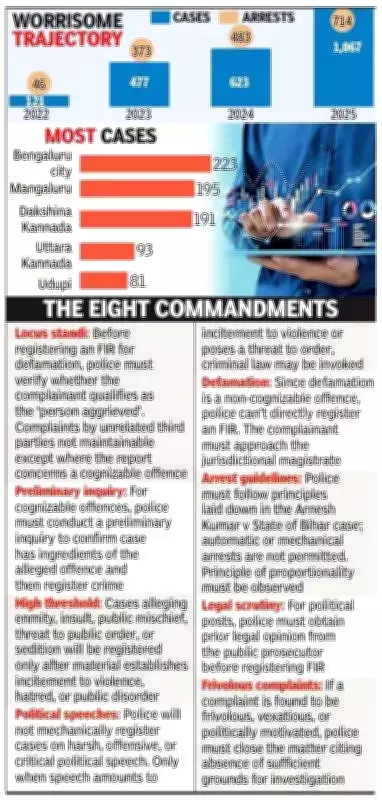
The new guidelines establish several critical procedural changes designed to prevent the misuse of legal mechanisms. Police officers are now required to conduct a preliminary inquiry before formally accepting any complaint related to social media content. Importantly, complaints filed by unrelated third parties are deemed non-maintainable under these new rules.
The guidelines explicitly state that cases involving harsh, offensive, or critical political speech will not be mechanically registered. Furthermore, if an investigation reveals that a complaint is frivolous, vexatious, or politically motivated, police authorities are directed to close the matter promptly without proceeding to formal charges.
Statistical Context and Case Volume
The implementation of these safeguards gains particular significance given the substantial volume of social media cases in Karnataka. Between 2022 and 2025, the state registered an alarming 2,288 cases linked to offensive or defamatory posts on various social media platforms. During this three-year period, authorities arrested 1,613 individuals in connection with these cases.
Law enforcement agencies have taken down 1,331 objectionable posts and permanently deleted 199 social media accounts as part of their enforcement actions. These statistics highlight the scale of digital content regulation that Karnataka police have been managing in recent years.
Legal Foundation and Judicial Precedent
The eight specific legal safeguards outlined by DG&IGP Saleem originate from directives established by the Telangana High Court, which were subsequently upheld by the Supreme Court of India. This judicial backing provides constitutional weight to the new procedural requirements being implemented across Karnataka's police departments.
The police chief's circular came in direct response to a representation filed by Bengaluru-based advocate Girish Bharadhwaj on February 6. In his communication to the DG&IGP, Bharadhwaj highlighted concerns about "mechanical" registration of First Information Reports (FIRs) and subsequent arrests in certain social media-related cases.
"Defamation is a non-cognizable offence and cannot be the subject of an FIR without a magistrate's order," Bharadhwaj emphasized in his letter. "Political and critical speech enjoys constitutional protection unless it amounts to incitement to violence or public disorder, and arrests must strictly comply with established safeguards."
Immediate Implementation and Official Statements
Acting swiftly on the advocate's representation, Saleem issued the comprehensive circular the very next day, demonstrating the police department's commitment to procedural reform. The top police officer maintained that all previous cases had undergone proper legal vetting before registration.
"All cases registered so far were booked only after taking legal opinions," Saleem told media outlets. "Since the Supreme Court has laid down specific guidelines, we are now ensuring strict adherence to them in all future proceedings."
Additional Director General of Police R Hitendra provided further context about the nature of previous cases. He revealed that most individuals booked in social media cases were politically affiliated persons or ideological followers who had posted abusive or defamatory content intentionally.
"No innocent persons were booked in these cases," Hitendra stated. "The acts were intentional and malicious. In some instances, fans of celebrities were also booked for defamatory posts, though their numbers remain comparatively lower than politically motivated cases."
The new guidelines represent a significant shift in how Karnataka police will approach digital content regulation, balancing enforcement needs with constitutional protections for free speech, particularly in the politically charged environment of social media discourse.