Karnataka Consumer Courts Face Persistent Gender Leadership Gap
Bengaluru: A bittersweet gender situation prevails in Karnataka's consumer courts, with no woman holding the top presidential position over the past five years, according to the India Justice Report's Consumer Justice Report 2026. This leadership void contrasts with some positive trends in member representation, highlighting a complex landscape for gender equity in consumer justice institutions.
National Decline in Women's Representation
The overall national trend offers little comfort. Women's share in state consumer commissions across India declined from an average of 35% in 2021 to 29% in 2025, hitting a concerning low of 23.2% in 2024. This decline occurs paradoxically during a period when women's economic participation is steadily rising nationwide, suggesting institutional barriers persist despite broader societal progress.
Karnataka's Mixed Performance
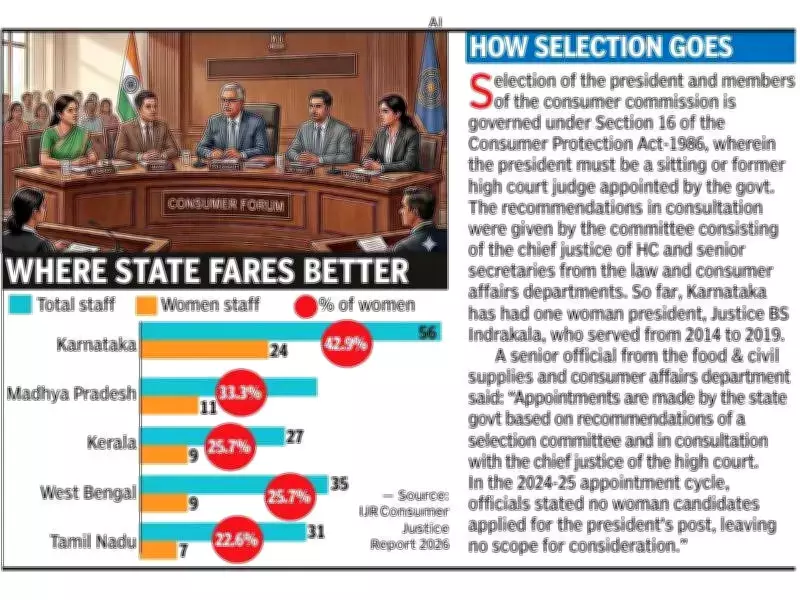
Among large states, Karnataka performed relatively better in member representation. However, the leadership gap remains stark both statewide and nationwide. Data reveals that 11 out of 21 state commissions lacked a woman president in both 2024 and 2025, excluding Delhi and Odisha. Notably, Kerala has not had a woman president in consumer courts for the past five years either.

For context, Karnataka has had only one woman president in its history—Justice BS Indrakala, who served from 2014 to 2019. In 2024, women accounted for 50% of members at the State Consumer Disputes Redressal Commission (SCDRC), even as the state had no woman president. Additionally, women comprised 42.9% of SCDRC staff—the highest percentage among all large states, indicating some progress at operational levels.
Bengaluru District-Level Data Shows Fluctuations
Data from four Bengaluru district commissions reveals nuanced trends. While total staff increased from 40 to 44 between 2021 and 2025, women's representation actually dropped from 25 to 21 during this period. Bengaluru Urban II additional court recorded the highest share, with women making up 82% of its staff—eight out of eleven members—in 2025, showing significant variation across different courts.
Activists Highlight Structural Barriers
Against this backdrop, activists acknowledge Karnataka's relatively better performance in staffing and member representation but emphasize that the absence of a woman president underscores a persistent glass ceiling in consumer justice institutions.
YG Muralidharan, founding member of the Consumer Rights Education and Awareness Trust (CREAT), stated: "Despite provisions under the Consumer Protection Act for women members, leadership positions continue to be dominated by men due to a lack of systemic support. Unless there is structural intervention, such as reserving the post of president or chairman for women, this imbalance is unlikely to change. The government must examine global practices and consider stronger provisions to ensure both better representation and more effective consumer protection."
Sujatha V, advocate and consumer activist, explained: "Currently, very few women are entering consumer activism or consumer law practice. But if more women join, it will significantly improve accessibility. The government should actively encourage women's participation by amending laws and creating stronger enabling mechanisms to ensure better representation and inclusion."
Officials noted that according to existing law, there is no reservation for women in presidential posts in consumer commissions, which may contribute to the ongoing disparity.
Broader Implications for Consumer Justice
This gender gap in leadership positions raises questions about the inclusivity and effectiveness of consumer protection mechanisms. With women increasingly participating in the economy as consumers and professionals, their underrepresentation in decision-making roles could impact the responsiveness of these institutions to diverse consumer needs.
The report's findings suggest that while Karnataka shows some promising signs at the member and staff levels, systemic changes are necessary to break the glass ceiling at the highest levels of consumer justice administration.