Legal Panel at Jaipur Literature Festival Condemns Extended Detention Without Trial
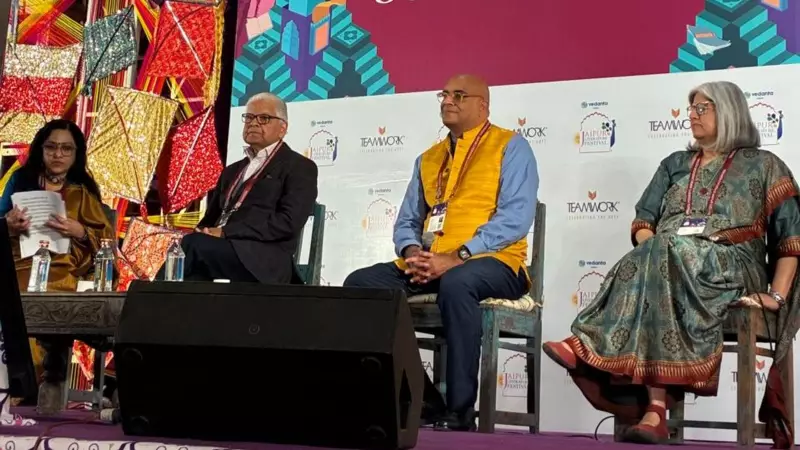
The Jaipur Literature Festival hosted a powerful discussion on justice and constitutional values this Saturday. Legal practitioners and former policymakers gathered for a session titled 'The Measure of Justice'. They tackled pressing issues including prolonged incarceration, free speech protections, and India's anti-terror legislation.
Focus on Broader Patterns Beyond Individual Cases
Senior advocate Vrinda Grover addressed the denial of bail to Umar Khalid and Sharjeel Imam in the 2020 Delhi riots conspiracy case. She argued that focusing solely on individual names misses a critical point. "The real issue is not Umar or Sharjeel," Grover stated. "Many similar cases exist. The true problem lies in the abuse of power and the weaponization of criminal law by the state."
Grover highlighted cases involving journalists and human rights activists in Kashmir. She noted they remain in custody or have been transferred to distant prisons. The use of terror laws in dissent-related cases extends far beyond the Delhi riots, she emphasized.
Neither Khalid nor Imam faces accusations of committing violent acts. "No one claims Umar or Sharjeel ever engaged in a single act of violence," Grover said. "The problem stems from their ideas. Their thoughts are under scrutiny."
Questioning Legal Reasoning and Protected Speech
Grover challenged the bail judgment's reasoning, particularly its mention of speeches that allegedly "destabilised civic life". "We globally debate what constitutes a terrorist act," she remarked. "However, removing violence entirely from the definition of terrorism is extremely dangerous."
She referenced constitutional jurisprudence, noting Indian courts historically distinguish between protected and prohibited speech. "The line is crossed only with incitement to imminent violence," Grover explained. "Read the judgment. Where is the link between these student leaders' speeches and the Delhi violence?" Without such a link, she insisted speech must remain protected. "This judgment impacts all of us. It concerns our democracy directly," Grover concluded.
Former Law Minister Labels Pretrial Detention as Patently Unjust
Former Union law minister Ashwani Kumar spoke next. He described prolonged pretrial detention as "patently unjust". "There is absolutely no justification for denying bail to two individuals for over five years without even starting a trial," Kumar asserted.
Such detention violates fundamental criminal justice principles and constitutional values, he argued. "It contradicts the core principles not just of the criminal justice system, but also of a dignitarian democracy," Kumar stated. He described Indian democracy as resting equally on dignity and liberty.
"Our democracy is anchored in freedom, liberty, free speech, inclusion, and plurality," Kumar said. Prolonged incarceration without trial weakens each of these essential pillars, he warned.
Highlighting Omissions in the Legal System
Grover also drew attention to cases the criminal justice system fails to pursue. "We discuss registered cases," she noted. "But sometimes omissions matter equally." She referenced alleged instances of hate speech and incitement during the 2020 Delhi violence that saw no legal action.
"Today's criminal legal system has become totally distorted and controlled," Grover argued. Kumar echoed concerns about fairness, criticizing public commentary by political leaders on pending criminal cases. He said such remarks create perceptions of guilt and violate the right to a fair trial, a right the Supreme Court recognizes as part of the Constitution's basic structure.
Examining Judicial Review and Restraint
Kumar discussed judicial review's role within India's constitutional framework. He described it as a safeguard recognized as part of the basic structure. He also mentioned the need for restraint in exercising judicial power.
"Judicial review must involve restrained exercise of judicial power," Kumar said. Persistent conflict between judiciary and Parliament could lead to a "disharmonious construct" among state organs. However, restraint should not mean passivity, especially regarding personal liberty. Courts must not be "disdainful of democratic politics," but they cannot abandon their role as constitutional guardians, he clarified.
US Judge Provides Comparative Perspective
US-based judge Ketu Shah offered a comparative viewpoint. "Judges are human beings," Shah stated. "We make mistakes. We strive for neutrality, fairness, and lack of bias. Sometimes we succeed, sometimes we don't."
He cited the 1923 US Supreme Court decision denying citizenship to Bhagat Singh Thind, an Indian-origin World War I veteran, on racial grounds. The ruling reflected its era's prejudices and was later reversed in spirit. "Interpretations change over time," Shah noted, adding Thind eventually received citizenship. "The law evolves, but often only after injustice occurs," he observed.
Debating Criminal Law Reform and Accountability
The panel also examined the Bharatiya Nyaya Sanhita, which replaced the Indian Penal Code last year. While presented as a decolonizing reform, Grover questioned if it genuinely advances constitutional freedoms.
"Was the law truly decolonized?" she asked. She pointed to continued immunities for public servants, expanded speech-related offences, and the failure to criminalize torture. "Where is the decolonization?" Grover pressed.
On torture, she asked why India still lacks a specific law making it a criminal offence. Kumar recalled chairing a parliamentary committee that proposed an anti-torture law, which never got enacted. A petition he later filed in the Supreme Court on this issue remains pending, he added.
The JLF session underscored deep concerns about justice, liberty, and legal processes in contemporary India. Legal experts called for greater scrutiny of prolonged detentions and the application of laws affecting fundamental rights.