

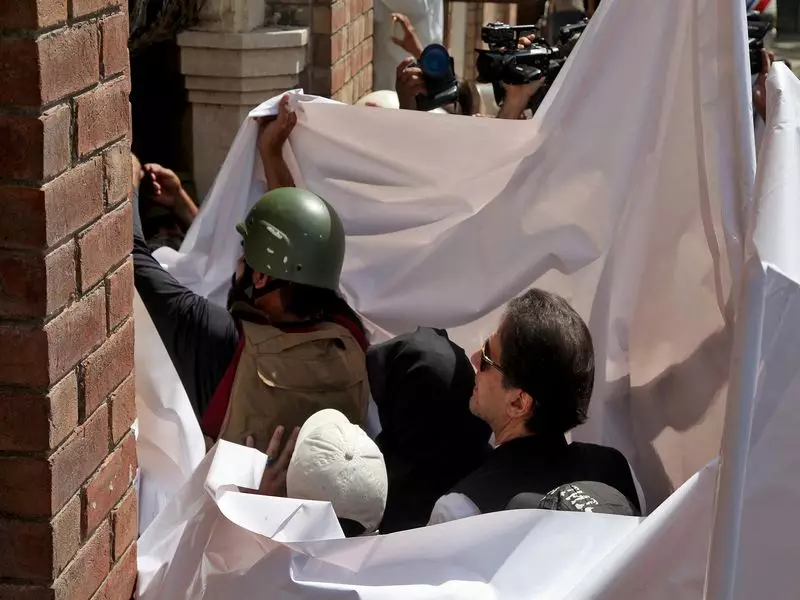
In a major legal and political development, a Pakistani accountability court has handed down severe sentences to former Prime Minister Imran Khan and his wife, Bushra Bibi. The couple was convicted in the high-profile Toshakhana corruption case, receiving 14-year prison terms each and being barred from holding any public office for a decade.
The Court's Verdict and Immediate Fallout
The verdict was delivered by Judge Mohammad Bashir at Adiala Jail in Rawalpindi, where the proceedings were held. Beyond the prison sentences, the court imposed a staggering collective fine of 1.54 billion Pakistani rupees on the former premier and his spouse. The ruling mandates that both must serve the sentence concurrently, meaning they will spend 14 years behind bars.
This conviction represents the third legal setback for Imran Khan in a short span, significantly impacting his political future. The judgment comes just days before Pakistan's general elections scheduled for February 8, effectively eliminating Khan from the electoral race due to the disqualification clause.

Details of the Toshakhana Corruption Case
The Toshakhana is a state repository where gifts received by government officials from foreign dignitaries are stored. The case against Imran Khan and Bushra Bibi centered on allegations of illegally selling state gifts worth more than 140 million Pakistani rupees that were received during Khan's tenure as prime minister from 2018 to 2022.
Investigators accused the couple of not properly declaring these valuable items and profiting from their sale instead of depositing them in the Toshakhana as required by law. The court found them guilty of misusing their official position for personal gain, constituting a serious breach of trust.
A Series of Legal Convictions for the Former PM
This latest sentence adds to Imran Khan's growing legal troubles. Earlier this week, he received a 10-year prison sentence in a separate case related to leaking state secrets, known as the cipher case. In that matter, he was convicted along with former Foreign Minister Shah Mahmood Qureshi.
Furthermore, last August, Khan was convicted in another Toshakhana-related matter and sentenced to three years in prison. That conviction led to his initial disqualification from contesting the upcoming national elections. The cumulative effect of these judgments paints a grim legal picture for the founder of the Pakistan Tehreek-e-Insaf (PTI) party.
Political Context and Reactions
The timing of these verdicts, just before the February 8 polls, has intensified the already charged political atmosphere in Pakistan. Imran Khan's party has consistently labeled these cases as politically motivated attempts to sideline him from the electoral process. Supporters of PTI are likely to view this as a concerted effort to dismantle the party's leadership ahead of the crucial vote.
Legal experts note that the sentences can be appealed in higher courts. However, the immediate consequence is the formal disqualification of Imran Khan from holding public office for the next ten years, a provision under Pakistani law for convicted individuals.
The case underscores the ongoing tensions between the powerful military establishment, the judiciary, and political figures in Pakistan. As the nation prepares for elections, these convictions ensure that the political landscape remains deeply polarized, with Khan's substantial popular support base reacting to what they perceive as an unjust legal assault on their leader.






