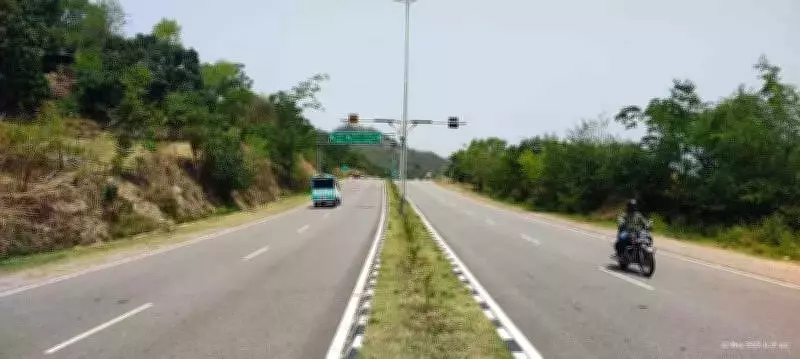
Himachal Forest Department Issues Stern Directive to NHAI Over Highway Demarcation
The Himachal Pradesh forest department has escalated its concerns by formally instructing the National Highway Authority of India (NHAI) to urgently demarcate the Kiratpur–Manali highway through the installation of boundary pillars. This measure aims to curb the illegal occupation of government land by encroachers, which has become a persistent issue along this critical route.
Repeated Non-Compliance Sparks Official Action
In a recent communication, Mritunjay Madhav, the Conservator of Forests for the Bilaspur Forest Circle, addressed NHAI project director Varun Chari, highlighting a failure to address previous reminders. The letter explicitly states that the NHAI has not repaired or reinstalled damaged and missing boundary pillars along the Kiratpur–Nerchowk stretch, despite multiple notifications.
The absence of these pillars poses a severe threat of encroachments on forest land adjacent to the highway, directly contravening Condition 18 of the final approval granted by the Ministry of Environment, Forest and Climate Change (MoEFCC) for the diversion of forest land for the highway project.
Verification Committee Confirms Lapses
A verification committee, established to assess the status of boundary pillars, corroborated the non-compliance in its report, confirming that previous directives regarding repairs and reinstallations have been ignored. This finding underscores the urgency of the situation, as unchecked encroachments could lead to irreversible damage to forest ecosystems.
Madhav has directed the NHAI to immediately undertake the repair and reinstallation of all missing and damaged boundary pillars without further delay. Additionally, the NHAI project director must ensure full compliance and submit a detailed action-taken report to the forest department office. Failure to adhere to these instructions may result in legal action under relevant provisions of the law.
Judicial and Public Concerns Amplify the Issue
The Himachal Pradesh High Court previously expressed alarm over encroachments along the highway during a hearing on a petition filed by Madan Lal Sharma, General Secretary of the Fourlane Visthapit and Prabhavit Samiti (FVPS). The court noted that encroachments undermine the purpose of the four-lane national highway and recommended cutting off utilities like water and electricity to illegal occupants.
Encroachments along the highway not only jeopardize forest land but also endanger commuter and pedestrian safety, as illegal constructions create accident-prone black spots. In response, the NHAI identified 91 illegal encroachments in Bilaspur district last year, including 50 temporary and 41 permanent structures, and issued notices to the encroachers.
Scope of Illegal Constructions and Safety Risks
The illegal structures that have emerged along the Kiratpur–Manali highway encompass a range of commercial and residential establishments, such as hotels, shops, dhabas, liquor vends, and houses. Some of these constructions are perilously close to the highway edge, forming zones with high accident potential, which compromises road safety for all users.
Opened for traffic in August 2023 and formally inaugurated by Prime Minister Narendra Modi on March 11, 2024, the Kiratpur–Nerchowk section remains vulnerable due to inadequate demarcation. According to Madan Lal Sharma, the NHAI's failure to install Right of Way (ROW) pillars, which delineate the exact width and limits of acquired land, has effectively invited encroachers.
Grassroots Voices Highlight Systemic Failures
Sharma further criticizes the NHAI for not installing concrete boundary pillars or replacing damaged ones along numerous stretches between Kiratpur and Manali, even nearly three years after the highway's opening. This negligence has led to mass encroachments and the creation of accident-prone spots, exacerbating risks for travelers.
In some areas, the NHAI opted for plastic pillars instead of durable concrete ones, with none bearing ROW markings, making them appear temporary and ineffective. This substandard approach highlights a broader pattern of oversight that threatens both environmental conservation and public safety on one of Himachal Pradesh's key transportation corridors.