Bombay High Court Directs Reconstruction of 1971 Birth Record in Goa
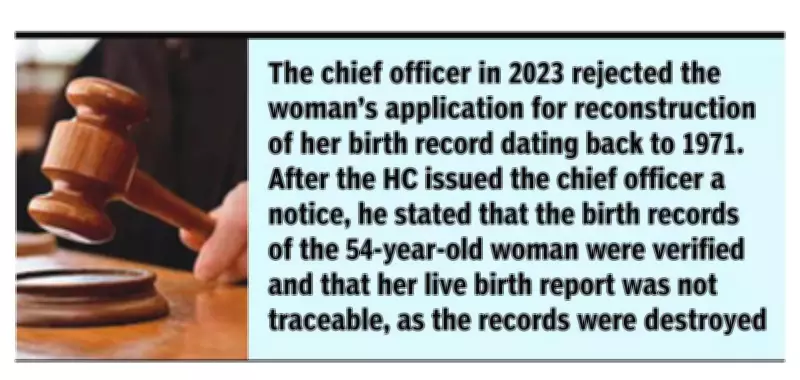
The Bombay High Court has issued a significant directive to the chief officer of the Margao Municipal Council (MMC) in Goa, ordering a fresh consideration of a woman's application to reconstruct her birth record dating back to 1971. This legal intervention comes after the chief officer initially rejected the application in 2023, citing issues with the historical records.
Background of the Case and Initial Rejection
The case involves a 54-year-old woman whose application for the reconstruction of her birth record was turned down by the MMC chief officer last year. The rejection was based on the assertion that her live birth report could not be traced, as the relevant municipal records had been destroyed. Furthermore, the chief officer noted that birth and death registration records from the period 1971 to 1976 were in a severely mutilated condition within the council's office, complicating the verification process.
Court's Intervention and New Evidence
Following the High Court's issuance of a notice to the chief officer, it was revealed that the South Goa District Hospital, formerly known as Hospicio hospital, had confirmed sending a record of live birth to the municipality at the time of the woman's birth. This crucial piece of evidence prompted the court to take decisive action. Justice Valmiki Menezes presided over the case and emphasized the importance of addressing the application with the newly available information.
Detailed Court Directives and Timeline
In his ruling, Justice Menezes outlined specific steps for the chief officer to follow. The chief officer is now required to reconsider the application in light of the valid record of live birth provided by Hospicio hospital. The reconstruction of the birth records must adhere to the prescribed procedure for such cases, with the entire process to be completed within three weeks from the receipt of the application.
The court further clarified that once the 1971 birth record is successfully reconstructed, the chief officer must make a corresponding entry in the birth register. Additionally, any fresh registration of birth that was previously effected in the petitioner's name must be deleted to prevent duplicate records. This deletion is to be carried out simultaneously with the entry made upon the reconstruction of the 1971 record, ensuring consistency and accuracy in the municipal archives.
Implications and Broader Context
This ruling highlights the challenges faced by individuals seeking to rectify or reconstruct vital records from decades past, especially when original documents have been damaged or lost. It underscores the judiciary's role in ensuring that administrative bodies fulfill their duties in preserving and maintaining accurate public records. The case also serves as a reminder of the legal avenues available to citizens when their applications are unjustly denied, reinforcing the principle of fair consideration based on available evidence.
The directive from the Bombay High Court is expected to set a precedent for similar cases involving the reconstruction of historical records in Goa and potentially other regions. By mandating a swift resolution within a three-week timeframe, the court aims to provide timely relief to the petitioner while upholding the integrity of the record-keeping system.