Rajasthan High Court Takes Strict Action Against Illegal Temple Constructions in Jaipur
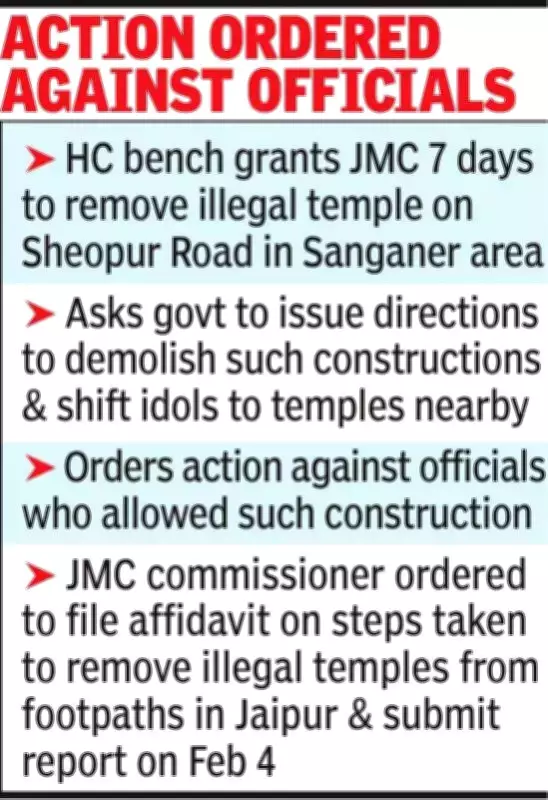
The Rajasthan High Court has issued significant directives to the Jaipur Municipal Corporation (JMC) concerning the removal of unauthorized temple constructions from footpaths across the city. In a decisive move, the court has mandated the civic body to submit a detailed affidavit outlining the specific steps taken to address this persistent issue of encroachment on public pathways.
Court Orders Demolition and Relocation of Idols
A division bench comprising Acting Chief Justice Sanjeev Prakash Sharma and Justice Sangeeta Sharma has instructed the state government to issue formal directions for the demolition of these illegal structures. Furthermore, the court has ordered that any idols from these unauthorized temples be respectfully shifted to nearby recognized and legally established temples. This directive aims to balance religious sentiments with urban planning regulations.
PIL Hearing in Sanganer Area Case
The court's orders emerged during the hearing of a Public Interest Litigation (PIL) that challenged the construction of a temple on a road in Jaipur's Sanganer area. The bench granted a strict seven-day deadline for the removal of this particular construction and the relocation of the idol, if present, to an existing temple. The court expressed clear disapproval, noting from photographic evidence that the temple was built without any proper authorization.
"We notice that the construction of the temple has been done, as is apparent from the photographs attached in this petition, without authorisation. The officers who were responsible for allowing this construction also deserve to be held responsible. Departmental action shall be taken against the officers concerned," the court firmly directed, emphasizing accountability among municipal officials.
Municipal Officials Directed to Report Actions
The High Court has specifically directed the JMC's deputy commissioner of the Sanganer zone to inform the court about the planned actions by the agency. Additionally, the JMC commissioner has been ordered to file a comprehensive affidavit detailing the measures undertaken to remove all illegal temples from footpaths throughout Jaipur. The matter has been scheduled for a follow-up hearing on February 4, with the Sanganer deputy commissioner required to be present and submit his report.
Background of the PIL and Encroachment Details
Appearing for the petitioners, counsel Amit Gupta presented the case, highlighting significant encroachment issues. "Some residents of Sanganer filed a PIL submitting that a resident of Sheopur had encroached on Sheopur Road through the permanent construction of a shop as well as a temple of Shri Bhomiya Ji, due to which the width of Sheopur Road had been reduced to a paltry four metres," Gupta explained.
The petitioners revealed that the housing board had conducted its own measurements of the road. Through a response to an RTI query dated November 17, 2015, the petitioner was "shocked to learn of the extent of encroachment." A formal complaint was submitted on July 14, 2016, to the JMC commissioner and the housing engineer, notifying them about the permanent constructions and temple erected on the road, which constituted clear encroachment.
This judicial intervention underscores the ongoing challenges of urban encroachment in Indian cities and the judiciary's role in enforcing civic regulations to maintain public infrastructure and order.