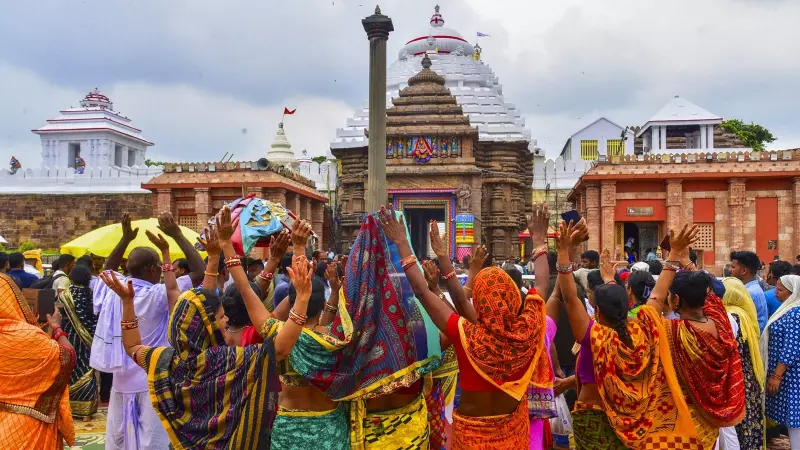
The Orissa High Court has delivered a significant ruling, dismissing a petition that sought to compel the administration of the revered Lord Jagannath Temple in Puri to sell a piece of its property. The court firmly anchored its decision in a long-standing legal doctrine, reiterating that a Hindu deity is considered an 'eternal minor' under the law.
Court Upholds Century-Old Legal Doctrine
Justice Krishna Shripad, presiding over the case, rejected the plea filed by a private individual. The petitioner had requested the court to direct the temple administration to allow him to purchase a specific property, arguing it aligned with a state government policy. The court, however, found no merit in this argument.
In its order, the bench explicitly stated, "It has long been settled since the days of the Privy Council that a Hindu deity is an eternal minor and therefore, a minor’s property cannot be sold in the absence of statutory enablement." This principle effectively places the deity's assets under a protective legal shield, similar to those guarding a child's property.

Petitioner's Claim and Legal Reasoning
The petitioner's counsel, advocate G C Rout, contended that his client had been in possession of the property for decades. He argued that statements from high-ranking state functionaries and an existing government policy created a 'legitimate expectation' for the sale to proceed. Therefore, the rejection of his application to buy the land was deemed unsustainable.
The court methodically dismantled this claim. It referenced Salmond’s Jurisprudence, noting that ownership includes a bundle of rights, one of which is the right to alienate (sell) property. Crucially, the court pointed out, "The right to alienate necessarily includes the right not to alienate." The bench observed that no specific statute was presented that mandated the temple to sell its property under the cited policy. Merely because an offer was made by a citizen, the court clarified, does not obligate the temple or government authorities to accept it.
Background: The 2022 Temple Act Amendment
This case is set against the backdrop of the 2022 amendments to the Sri Jagannath Temple Act, 1954. These changes granted the temple administration and its officials the power to sell or lease temple land without needing prior approval from the state government. Prior to this amendment, long-term occupants of temple land had to approach the state government for any sale or transfer.
The amendment was part of a broader framework to manage the temple's vast assets. Official records indicate that Lord Jagannath owns approximately 60,426 acres of land across 24 districts in Odisha, with additional holdings in states like West Bengal, Maharashtra, and Madhya Pradesh. A significant portion of this land has been occupied by individuals, schools, and hospitals for over 50 years.
Since 2003, the temple administration has followed a policy of allowing occupants to purchase the land or take it on lease, rather than initiating eviction drives. This settlement process has led to the transfer of nearly 387 acres between 2001 and 2021, generating over Rs 11.20 crore in revenue for the temple, as confirmed by Law Minister Pratap Jena in the state assembly.
The High Court's latest judgment reinforces that while the temple administration has the *power* to sell under the amended act, it is not *compelled* to do so. The fundamental legal protection of the deity as a minor remains the paramount consideration, ensuring that any alienation of property is solely for the deity's benefit and not due to external pressure.