Bombay High Court Takes Suo Motu Action to Protect 1,200-Year-Old Temple from Illegal Mining
The Nagpur bench of the Bombay High Court has taken a significant step to safeguard historically important archaeological sites in Maharashtra's Chandrapur district. Acting on its own motion, the court has initiated a public interest litigation to address the threat posed by alleged large-scale illegal mining near a 1,200-year-old temple site.
Court Acts on News Reports, Appoints Amicus Curiae
A division bench comprising Justices Anil Kilor and Raj Wakode took cognizance of two news reports published in The Times of India on January 4 and February 5. Treating these reports as the basis for a suo motu PIL, the court appointed advocate Bhanudas Kulkarni as amicus curiae to examine the ground situation and provide legal assistance in this crucial matter.
Following the court's directives, Kulkarni led a comprehensive site visit to Bhatala and Mowad villages in Warora taluka last month. The inspection team included archaeologists, academicians, and conservation specialists who meticulously documented the historical and archaeological significance of these locations through detailed reports and photographic evidence.

Court Appreciates Efforts, Notes Departmental Failures
The court recorded its appreciation for the painstaking efforts of the expert team and local villagers who assisted in identifying and documenting key archaeological locations. In its observations, the bench specifically noted that "the above-referred persons have put in a lot of efforts" to bring this critical matter to judicial attention.
Upon reviewing the submitted material, the bench made a significant observation: "Proper care of these prehistoric archaeological sites has not been taken by the concerned departments, despite being aware of its importance and significance." The court also took note of development plans and conservation measures suggested by the amicus curiae for long-term protection of these heritage sites.
Illegal Mining Identified as Primary Threat
A central concern highlighted before the court was the ongoing illegal mining activity in the vicinity of these precious heritage sites. The bench explicitly noted that "Illegal mining is going on a large scale, which is causing damage to the sites," emphasizing the urgent need for judicial intervention to prevent further destruction.
Court Issues Directives to Authorities
The High Court has issued notices to multiple authorities including:
- The Union of India
- Various state government departments
- The Chandrapur district collector
The court has directed the Chandrapur collector to personally inspect the mining site and submit a comprehensive report by April 18. This report must specifically address:
- Whether any mining permissions were granted in the area
- If no permissions exist, identification of officials responsible for failing to prevent illegal operations
The bench issued a stern warning that failure to comply with this directive would require the collector to remain personally present before the court on the next hearing date, scheduled for April 20.
Historical Significance of the Temple Site
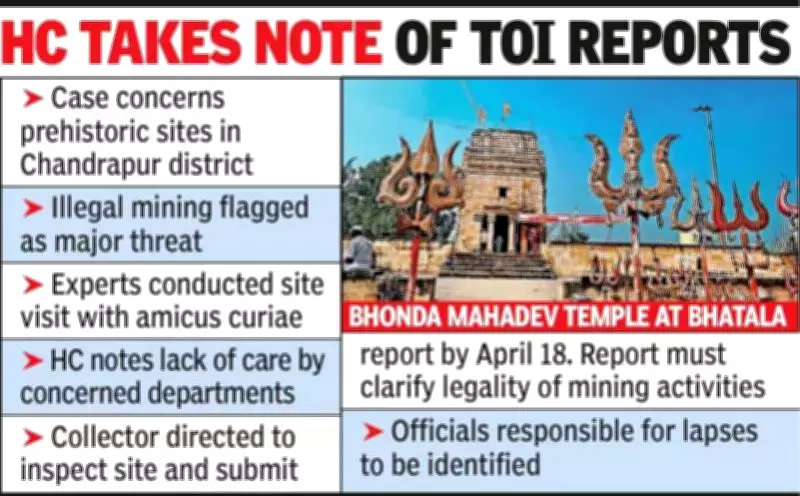
The Bhonda Mahadev temple at Bhatala represents a remarkable piece of India's architectural heritage. Believed to date back to the eighth or ninth century during the Rashtrakuta period, this two-storey structure rises approximately 50 to 60 feet and is constructed from distinctive yellow sandstone.
The temple consists of a mandap and sanctum, with the latter housing one of the largest Shiva lingas in the entire Vidarbha region. This impressive linga is carved from a single block of black stone measuring nearly 10 feet in length and rising about 4 feet from the ground.
Interestingly, the temple is locally known as Bhonda Mahadev because it lacks a traditional spire. Scholars have noted that the origin of the massive black stone used for the linga remains unclear, as such stone is not naturally found in the surrounding geographical area.

The court has expressed expectation that central authorities will seriously consider the recommendations made by the amicus curiae for the long-term protection and preservation of these invaluable archaeological sites, ensuring that India's rich historical heritage is safeguarded for future generations.