Gujarat High Court Criticizes GPSC Over 'Eyewash' Affidavit in Exam Question Dispute
The Gujarat High Court on Friday strongly reprimanded the Gujarat Public Service Commission (GPSC) for submitting an affidavit that the court described as "merely an eyewash". This criticism came in response to the GPSC's explanation of its policy for authenticating information downloaded from the internet, which is used to frame questions in its competitive examinations.
Background of the Case
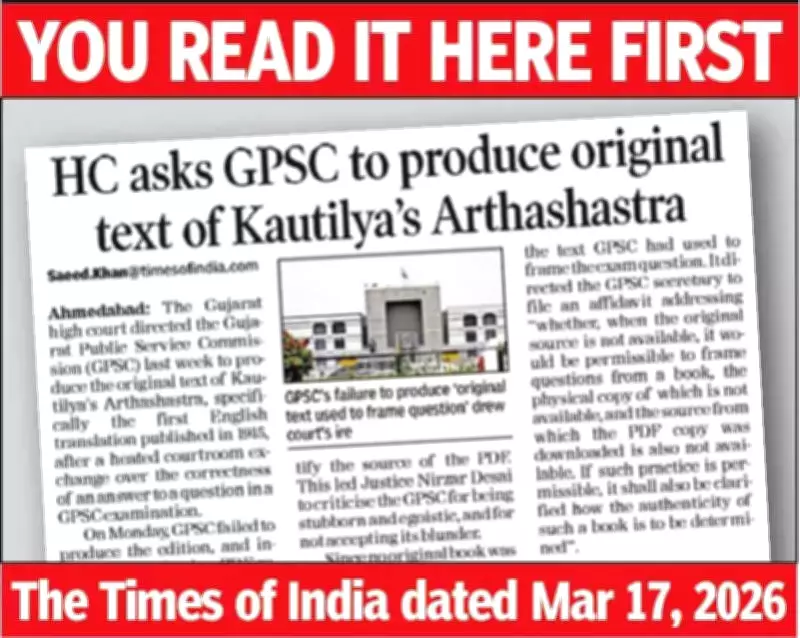
The dispute centers on a question from an exam conducted last year, where the correctness of the answer key is being challenged. A candidate, who needed just one more mark to pass the test, contested the GPSC's published answer key. The High Court had previously directed the GPSC to produce the original 1915 English translation of Kautilya's "Arthashastra", from which the commission claimed to have sourced the question.
On March 16, 2026, the GPSC failed to provide the physical copy of the book and instead submitted a PDF version downloaded from the internet. This prompted the court to demand a detailed affidavit from the GPSC secretary, seeking clarification on several critical issues.

Court's Specific Queries and GPSC's Response
The High Court posed specific questions to the GPSC, including:
- Whether it is permissible to frame exam questions from a book when the original source is unavailable and the internet source of the PDF is also unknown.
- How the authenticity of such material is determined in the absence of a physical copy.
In response, the GPSC secretary filed an affidavit on March 18, 2026. However, Justice Nirzar Desai expressed severe dissatisfaction, stating that the affidavit was "completely silent" on key aspects. He noted that it did not address how the PDF version could be considered authenticated or whether any policy exists for verifying such downloaded material.
High Court's Stern Directions
The court directed the GPSC secretary to file a new, detailed affidavit that must:
- Address all queries raised in the March 16 order specifically and thoroughly.
- Avoid vague or general submissions.
- Be based strictly on existing material or policies within the GPSC, not on subjective interpretations by administrators.
Additionally, the High Court reiterated its demand for clarification on whether the GPSC has any formal policy for authenticating internet-downloaded content. If no such policy exists, the commission must explain the basis for treating Kautilya's "Arthashastra" as an authenticated source.
Next Steps and Implications
The case has been scheduled for further hearing on April 2, 2026. This incident highlights significant concerns about the integrity and reliability of exam-setting processes in competitive tests conducted by public service commissions. It underscores the need for transparent and robust policies to ensure the accuracy and authenticity of educational materials used in high-stakes assessments.
The Gujarat High Court's intervention serves as a reminder to administrative bodies to adhere strictly to procedural norms and maintain accountability in their operations, particularly in matters affecting the careers of thousands of aspirants.