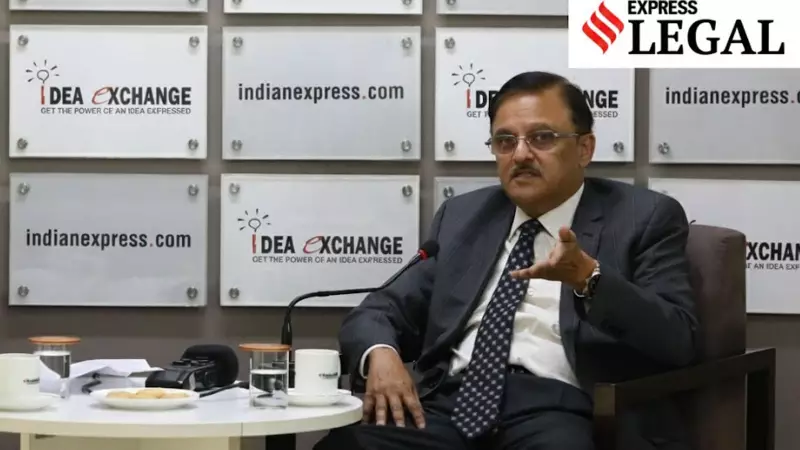
In a candid and wide-ranging discussion at a recent Idea Exchange session, former Supreme Court judge Justice Abhay S Oka shared profound reflections on the inner workings of the judiciary, the pressures of environmental activism, and the vital role of art in society. Having recently retired, Justice Oka, often described as the conscience keeper of the courts, offered rare insights into topics ranging from judicial discipline to constitutional duties.
The Imperative of Judicial Silence: Why Judges Should Not Talk to Media
Justice Oka presented a firm and clear stance on one of the most debated issues in legal circles: should sitting judges engage with the press? He firmly believes that a judge serving on the bench must refrain from speaking to the media. To lead by example, he imposed a self-ban on media interactions for three months post-retirement.
"The appearance of judges should be confined to law schools, law colleges, and official functions of the legal services authority or the court," he stated. However, he acknowledged a narrow exception for certain public events, such as the inauguration of new court buildings where state ministers are present, as infrastructure funding relies on government support.

He advised that unless one is attending an event as an alumnus, such as a school golden jubilee, judges should generally avoid sharing public platforms with politicians to maintain the perception of impartiality.
Defending Art and Accountability: Comedians, Errors, and Environmental Duty
Shifting to the realm of free speech, Justice Oka questioned the legal basis for framing guidelines to control social media, particularly concerning comedians. He asked which law would withstand the scrutiny of Article 19(1)(a) on free speech and Article 21 on the right to life.
"We have the right to live a dignified and meaningful life," he remarked, referencing his own past judgments. "If there are no comedians and there is no art and literature, we can't lead the life Article 21 gives us the right to." He clarified that the debate should be about social media regulation, not controlling artists, adding that social media criticism is often fleeting.
On the topic of judicial errors, Justice Oka displayed remarkable humility. He recalled publicly acknowledging a mistake in his 2016 Bombay High Court judgment, viewing such correction as a strength, not a weakness. "If judges accept their error and correct it in accordance with law, it enhances the common man's faith in the judiciary," he argued, citing the evolutionary journey from the Golaknath case to the Kesavananda Bharati verdict.
On Protecting the Planet and Its Protectors
Justice Oka expressed strong support for environmental activists, who he feels are unfairly maligned. "They deserve support and praise from society, which they usually don't get. Instead, everybody attacks them, calling them anti-religion or anti-national," he noted.
He shared a personal experience from 2017 when, as a Bombay High Court judge, he was hearing cases on noise pollution and road blockages for religious pandals. The Maharashtra government had moved an application alleging he held a bias against the state for not accepting its stand on 'silence zones'. The Bar Association strongly defended him, and the Chief Justice dismissed the application.
He lamented the collective failure in environmental stewardship. "It has been 75 years of the Constitution, and still we are not doing our duty of protecting and preserving the environment. It is the duty of every citizen," he emphasized, urging for greater public sensitization so that the burden does not fall solely on a few activists approaching the courts.
Reforming the Supreme Court's Administrative Structure
Justice Oka pointed out a significant structural difference between the High Courts and the Supreme Court, describing the apex court as overly "Chief Justice-centric." In High Courts, he explained, major administrative decisions are taken by a committee of three or five judges and often presented before the full court.

"In the Supreme Court, I found that many decisions on the administrative side are made by the Chief Justice alone," he observed, though he noted that committees now exist and some changes have been made. He also advocated for a fixed roster system in the Supreme Court, similar to High Courts, to ensure transparency and eliminate manual intervention in case allocation.
On the recent comments by Justice B V Nagarathna regarding the overturning of judgments, Justice Oka provided nuanced clarity. He agreed that a Supreme Court judgment can only be overturned through methods established by law, such as review or larger bench rulings. However, he added that the law is not static and evolves over time, as seen in the progression from the A K Gopalan case to the landmark Maneka Gandhi verdict.
Justice Abhay Oka's reflections paint a picture of a judiciary in continuous evolution, balancing its immense authority with accountability, silence with expression, and its duty to both the law and the citizen it serves.