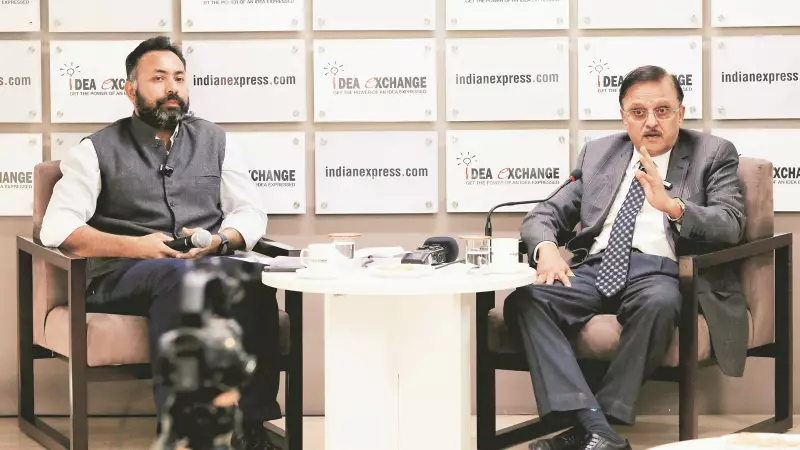
In a candid conversation at The Indian Express Idea Exchange, retired Supreme Court judge Justice Abhay Shreeniwas Oka delivered a powerful critique of India's ongoing failure to fulfill its constitutional duty of protecting the environment, even after 75 years of the Constitution. Widely regarded as a conscience keeper of the judiciary, Justice Oka discussed a range of pressing issues, from attacks on environmental activists and judges to the need for democratizing the Supreme Court and ensuring gender parity in the lower judiciary.
A Constitutional Duty Unfulfilled: The Environmental Crisis
Justice Oka expressed deep concern over the societal and institutional response to environmental protection. "It has been 75 years of the Constitution and we are still not doing our duty of protecting the environment," he stated emphatically. He pointed out that the responsibility currently rests on a handful of activists who raise issues and approach courts, while the broader citizenry remains disengaged.
He revealed that judges themselves face attacks on social media for passing strong orders on environmental matters. Recalling a 2017 incident from his tenure at the Bombay High Court, he shared how the Maharashtra government accused him of bias simply because he refused to accept its stand that no 'silence zones' existed after an amendment to the Noise Pollution Rules. The Bar, he noted, strongly supported him against this move.

On Judicial Independence, Overturning Rulings, and a CJI-Centric Court
The retired judge addressed the delicate issue of Supreme Court judgments being overturned. While acknowledging that law evolves over time, as seen in landmark shifts from the A.K. Gopalan case to Maneka Gandhi, he stressed that judgments cannot be discarded merely because they are disliked. He referenced the 'basic structure doctrine' established in the Kesavananda Bharati case, which limits Parliament's power to amend the Constitution's fundamental features.
On the administrative functioning of the Supreme Court, Justice Oka called for democratization, noting that the institution is heavily Chief Justice-centric. He advocated for adopting the High Court model, where an administrative committee of three or five judges takes major decisions, which are often presented before the full court. He also highlighted the lack of a fixed roster in the Supreme Court, unlike High Courts, which leaves room for discretion in case allocation.
Free Speech, Sensitive Society, and the Judiciary's Role
When asked about cases against celebrities for hurting religious sentiments, Justice Oka emphasized a strictly constitutional approach. The court's duty, he said, is to examine whether an offence is attracted based on the allegations. Even if judges personally dislike an utterance, they must grant relief if freedom of speech and expression is infringed.
Citing his own judgments, like quashing an FIR against poet Imran Pratapgarhi for an Urdu poem, he reiterated the principle that legitimate dissent should not be suppressed. The test should be that of a reasonable person, not a vacillating mind. On the issue of different Supreme Court benches having divergent views on fundamental rights, he stated simply that the Court is bound by the view of a coordinate bench and such variations should not exist.
Gender Diversity, Junior Lawyers, and Post-Retirement Roles
Justice Oka provided an optimistic outlook on gender diversity in the lower judiciary. He noted that with the entry age for civil judges now at 26-27, data from the last five to six years shows that over 50% of newly appointed judges in almost all states are women. He described this as a significant change over the past decade, predicting a gradual but positive shift in the higher judiciary as well, without compromising on merit.
Addressing the struggles of junior lawyers, he acknowledged the financial hardship during the initial years of practice. He suggested exploring a sustenance allowance for those from less privileged backgrounds to ensure survival in the profession.

On the contentious issue of post-retirement appointments for judges, Justice Oka shared his personal stance: he will not take up any work involving adjudication like arbitration. However, he noted that many statutes legally allow retired Supreme Court judges to head tribunals. He suggested that the idea of a cooling-off period, as once mentioned by the late Arun Jaitley, is worth considering.
Throughout the session, moderated by Aamir Khan of The Indian Express, Justice Abhay Oka reinforced his reputation as a judge deeply committed to constitutional principles, liberty, and the evolving conscience of Indian democracy.