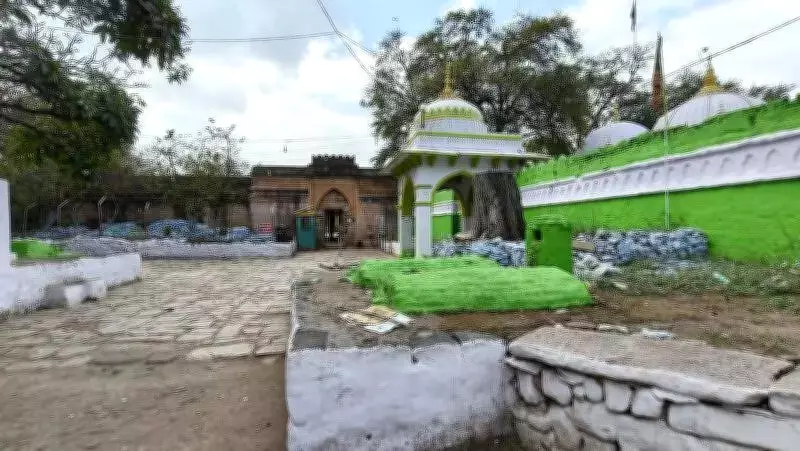
An intervenor in the Bhojshala-Kamal Maula Mosque case on Wednesday told the Indore bench of the Madhya Pradesh High Court that he is a direct descendant of Maulana Kamaluddin Chisti and opposed any attempt to alter the religious character of the site.
Family Lineage and Land Grants Presented
Qazi Moinuddin, represented by advocate NA Sheikh, informed the bench of Justice Vijay Kumar Shukla and Justice Alok Awasthi that his family's connection to the site spans several centuries. He supported his claims with documents, including sanats and land records. Sheikh, who filed the intervention in the petition by Hindu Front for Justice, submitted a family tree obtained from registrar records of the erstwhile Dhar federal court showing Qazi Moinuddin's lineage. He asserted that this lineage confers rights over the land, its customs and traditions, and the operation and maintenance of the Kamal Maula Mosque.
Sheikh relied on historical sanats to argue that parcels of land—100 bighas and later 50 bighas—were granted to the ancestors of Kamaluddin. These grants were issued by successive rulers of Dhar and reaffirmed over time in records, demonstrating continuous recognition.

Court Queries on Validity of Documents
The court sought clarity on the validity of the sanats, which appear to signify permission to use the land. Sheikh explained that the sanats were documents granting land ownership, passed down in the family either to the eldest son or to a designated son. He submitted khasra entries, specifically referencing khasra number 313—the disputed site—now reflected as survey number 604. He argued that the site and adjoining land were granted to Moinuddin's family. These entries, he said, establish uninterrupted and peaceful possession by the lineage, including the presence of structures such as the mosque within the recorded land.
The court questioned the ownership claim, noting that the Archaeological Survey of India (ASI) took over the disputed site as a protected monument in 1904. Sheikh, referencing an argument by senior advocate Shobha Menon, said there was no acquisition or notification to that effect. Any interruption or regulation in later years, including ASI's actions, does not negate the historical continuity of possession and use, he argued.
Religious Practices and Statutory Framework
The intervenor and his predecessors have continued to exercise rights over the site, including conducting religious practices, Sheikh added. He referred to the statutory framework governing ancient monuments and said entry and usage of a religious site must consider the concurrence of persons in charge of its religious affairs. Any arrangement affecting access or usage must account for the intervenor's role. He reiterated that the intervenor's rights, rooted in lineage, grants, and continuous possession, must be duly considered before any determination is made.
Arguments by Maulana Kamaluddin Welfare Society
The court also heard arguments from advocate Tousif Warsi, appearing for Maulana Kamaluddin Welfare Society, a respondent in the petition filed by Hindu Front for Justice. Warsi accused the ASI of filing 'mechanical replies' in three different petitions and shifting their stance on the same disputed site. He referred to a letter from a British high commissioner to the then Madhya Pradesh chief minister to argue that an idol housed in the British Museum in London is not of Vagdevi but of Ambika. Warsi also discussed historical aspects of Dhar and the disputed site to assert that no records show a temple was demolished to construct a mosque. He will continue his arguments on Thursday.