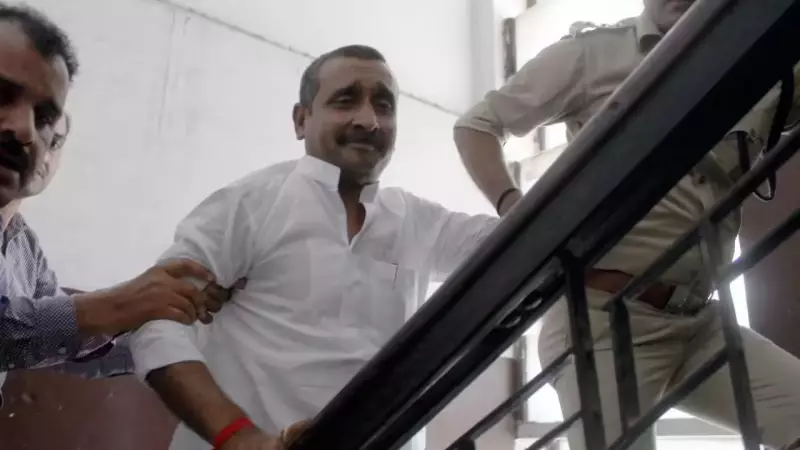
In a significant legal development, the Delhi High Court has suspended the life sentence of former Uttar Pradesh MLA Kuldeep Singh Sengar, who was convicted for the 2017 rape of a minor girl in Unnao. The court, in its order dated December 23, made a crucial observation that Sengar did not fall under the definition of a 'public servant' as per the Protection of Children from Sexual Offences (POCSO) Act.
Court's Rationale on POCSO's 'Public Servant' Definition
A bench comprising Justices Subramonium Prasad and Harish V Shankar scrutinized the applicability of a stringent section of the POCSO Act while hearing Sengar's plea for suspension of his sentence. This section mandates a minimum jail term of 20 years, extendable to life imprisonment. The bench found fault with the trial court's decision to treat Sengar as a public servant and sentence him to imprisonment for the "remainder of his natural life" for the offence of aggravated penetrative sexual assault under Section 5 of the POCSO Act.
The court concluded that the charge of aggravated penetrative sexual assault was not applicable in Sengar's case. Section 5 of the POCSO Act defines penetrative sexual assault against a minor as 'aggravated' if committed by individuals in positions of authority. This list includes public servants, police officers, armed forces personnel, and staff of hospitals or prisons acting within their jurisdiction.

Why MLA is Not a 'Public Servant' Under POCSO
The High Court noted a critical legal gap: the POCSO Act itself does not define who a 'public servant' is. It observed that the trial court incorrectly borrowed the definition from the Prevention of Corruption Act. The bench clarified that for interpreting the POCSO Act, one can only seek definitions from the Indian Penal Code (IPC), the Code of Criminal Procedure (CrPC), the Juvenile Justice (JJ) Act, and the Information Technology (IT) Act, as specifically mentioned in Section 2 of POCSO.
"Notably, CrPC, JJ Act, and IT Act do not provide for the definition of a public servant," the court stated. It pointed out that an MLA is not recognized as a public servant under the IPC or any of the other referenced statutes. Consequently, the court held that Sengar could not be convicted under the aggravated provisions of Section 5 of POCSO. The same reasoning was applied to set aside his conviction under Section 376(2)(b) of the IPC, which deals with rape by a public servant.
Survivor's Plea and Court's Decision on Sentence Suspension
The counsel representing the survivor opposed the suspension of Sengar's sentence. They argued that even if Sengar did not qualify as a 'public servant' under the specific clause of the POCSO Act, the court still had the authority to sentence him to life imprisonment.
However, the High Court bench was not persuaded. It expressed that it was prima facie satisfied that the offence under Section 5 of the POCSO Act was not made out against Sengar. The bench remarked that the survivor's contention about a compromised investigation "cannot be a ground not to suspend the sentence of the appellant, more so looking at the period of incarceration already undergone." This consideration of the time Sengar has already spent in jail played a role in the decision to suspend his sentence while his main appeal against the trial court's conviction remains pending for a final hearing.
This interim order has brought a controversial twist in the high-profile Unnao rape case, raising important questions about legal definitions and their application in punishing powerful individuals accused of heinous crimes against children.