In a landmark move, the Supreme Court of India has recently accepted a uniform, elevation-based definition for the Aravalli Hills, a decision with far-reaching consequences for the conservation of one of the world's oldest mountain ranges. This judicial acceptance follows the recommendations of a Centre-appointed expert committee and defines the Aravalli range as any landform located in the Aravali districts, having an elevation of 100 metres or more from the local relief. While this new criterion aims to bring clarity, it has sparked debate among environmentalists who fear hills below this threshold may lose vital legal safeguards.
A History of Judicial Guardianship
Long before this recent definition, Indian courts have repeatedly acted as the last line of defence for the ecologically fragile Aravallis. Their interventions have spanned decades, addressing threats from illegal construction and mining to large-scale commercial projects. Here are ten pivotal instances where the judiciary stepped in to protect this critical natural heritage.
Key Interventions Against Major Projects
In a significant order in October 2025, the Supreme Court directed the Haryana government to halt all work on the proposed Aravalli jungle safari project. A bench led by Chief Justice B R Gavai issued notice on a petition filed by retired IFS officers and the 'People for Aravallis' collective, which argued that the 10,000-acre safari park prioritized commercial tourism over the ecological restoration of a zone vital for Delhi-NCR's environmental health.

Similarly, in May 2025, the apex court issued show-cause notices to Delhi government officials and a private developer for alleged violations of its 1996 order in the M C Mehta case. The court questioned construction activity in Vasant Kunj's 'morphological ridge,' a sensitive part of the Aravalli range that acts as Delhi's green lung.
Cracking Down on Encroachment and Illegal Activity
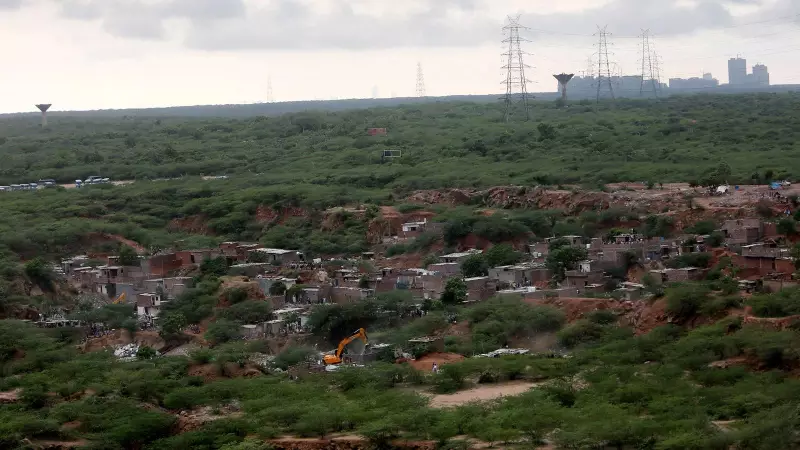
The courts have been unequivocal in their stance against encroachments. In 2021, the Supreme Court refused to stay its order for the removal of around 10,000 residential encroachments in the Aravali forest area near Faridabad's Khori village, asserting that forest land must be cleared. Earlier, in 2020, the Punjab and Haryana High Court mandated that no construction could occur in the Aravallis without permission from a Supreme Court committee or the Union Environment Ministry.
Illegal mining has been a persistent target. Expressing shock in 2018 over 31 'vanished' hills in Rajasthan's Aravalli area, the Supreme Court ordered the state to stop mining in 115.34 hectares within 48 hours, linking the destruction to rising pollution in Delhi-NCR. A decade earlier, in 2014, the court threatened to prosecute derelict Haryana officials for allowing illegal mining and stone-crushing units to proliferate.
Ensuring Accountability and Land Restoration
The National Green Tribunal (NGT) has also played a crucial role. In a recent order, it directed the Haryana State Pollution Control Board to submit an action plan for using over Rs 24.96 crore collected in environmental compensation from illegal mining to reclaim and rehabilitate the ravaged land in Gurgaon, Faridabad, and Nuh districts.
In 2022, the Punjab and Haryana High Court took up a petition by Lt Col Sarvadaman Singh Oberoi (Retd), seeking the restoration of 3,810 acres of 'gair mumkin pahar' (uncultivable forest land) in Mangar Bani, Faridabad, to the gram panchayat, highlighting how protected forest land was sold into private ownership.
The judiciary has also scrutinized legislative changes. In 2019, the Supreme Court warned the Haryana government of 'trouble' after it passed amendments to the Punjab Land Preservation Act (PLPA), which opened up thousands of protected acres for real estate. The court's warning was clear: it would not tolerate any tampering with the Aravalli hills or forest areas.

The Road Ahead: Implications of the New Definition
The Supreme Court's acceptance of the 100-metre elevation-based definition marks a new chapter. While Union Environment Minister Bhupender Yadav has clarified that it does not mean a relaxation for mining, environmental activists remain concerned. They worry that hills and landforms below this benchmark could be exposed to exploitation, disrupting the ecological continuity of the entire range.
The decade-long judicial saga underscores a fundamental conflict between developmental pressures and ecological preservation. As the courts continue to interpret and enforce this new definition, their role as the guardian of the Aravallis—a natural heritage crucial for water security, biodiversity, and clean air in north India—remains more critical than ever.