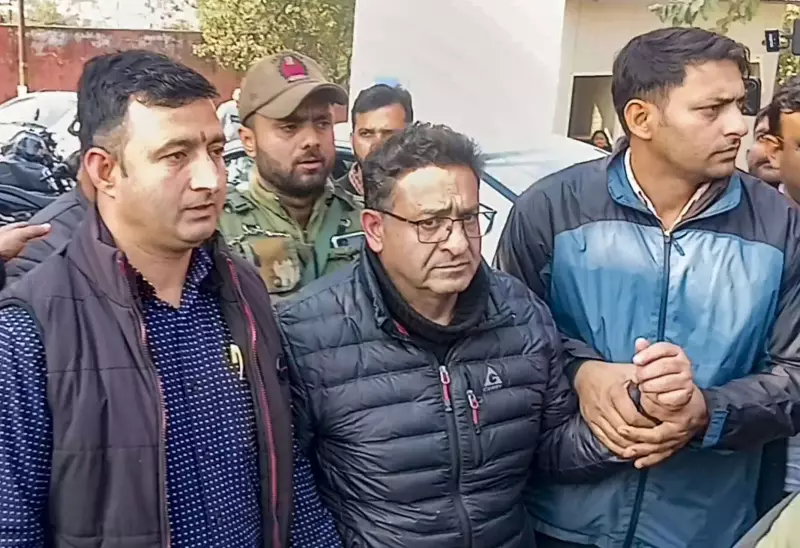
A court in Jammu delivered a significant ruling on Tuesday, rejecting the Central Bureau of Investigation's (CBI) application to remand an accused into judicial custody. The court also took the consequential step of cancelling non-bailable warrants issued against seven other suspects linked to a decades-old case.
Court Cites 1991 Chargesheet in Landmark Ruling
The case in question pertains to the alleged abduction of Mehbooba Mufti, daughter of the then Union Home Minister Mufti Mohammad Sayeed, in 1990. The CBI had sought the judicial custody of an individual named Shangloo, arguing he was part of the conspiracy with Yasin Malik. The agency's plea stated that Shangloo was mentioned among "others" in the First Information Report (FIR) registered at the Saddar police station in Srinagar on September 18, 1990.
However, the defence team, comprising lawyers Yogesh Bakshi and Anil Raina, presented a compelling counter-argument during the hearing. They pointed the court's attention to the official chargesheet filed in the case back in 1991. This crucial document placed Shangloo in a specific category: individuals who were "released for want of evidence".
Warrants Cancelled for Lack of Legal Grounds
The defence further emphasised that Shangloo was not among the accused formally declared as absconding. Therefore, legal proceedings under Section 512 of the Code of Criminal Procedure (CrPC), which were to be initiated based on a court order dated September 17, 1991, did not apply to him. This argument formed the bedrock of the court's decision.
Special Judge Madan Lal, presiding over the case, concurred with the defence's position. The judge observed that it appeared Shangloo's name was mistakenly included in the warrant. More importantly, Judge Lal ruled that a warrant cannot supersede or override the factual information officially recorded in the chargesheet. Since the 1991 document explicitly listed Shangloo as a person freed due to insufficient evidence, the court had no legal basis to grant the CBI's remand plea.
Implications and Next Steps
This ruling has immediate implications for the other seven suspects as well. The court cancelled the warrants issued against them on the identical ground that none of their names was listed as "absconding accused" in the original 1991 chargesheet. The decision underscores the primacy of documented legal records over subsequent investigative actions.
The court's firm stance highlights the importance of procedural accuracy in long-pending cases. By anchoring its judgment on the specifics of the three-decade-old chargesheet, it has temporarily closed this particular legal avenue for the investigative agency concerning these individuals. The CBI will now have to explore other legal options if it wishes to pursue the matter further against Shangloo and the others.