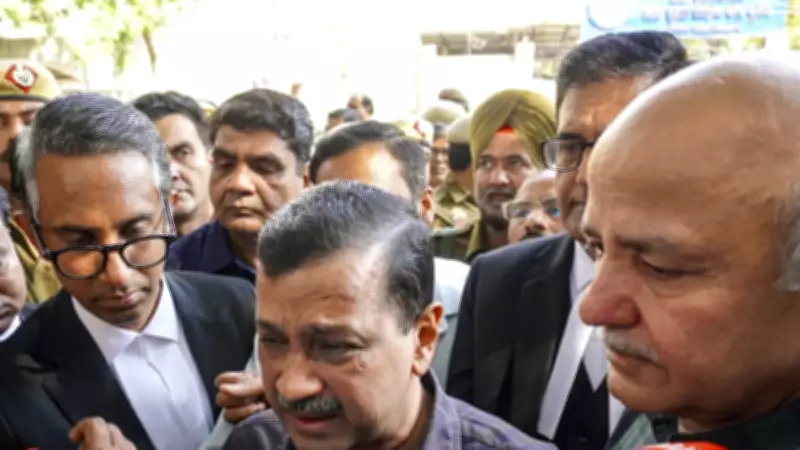
Delhi Court Discharges Arvind Kejriwal and 21 Others in Liquor Policy Case, Criticises CBI's Use of 'South Group' Label
A Delhi court on Friday discharged former chief minister Arvind Kejriwal, former education minister, and 21 other individuals in the high-profile liquor policy case. The court delivered a sharp rebuke to the Central Bureau of Investigation (CBI), criticising the agency for repeatedly employing the term "South Group" in its chargesheet. Special Judge Jitendra Singh emphasised that this nomenclature lacks any legal basis and urged the agency to exercise greater restraint in its investigative language.
Court's Strong Criticism of CBI's Regional Labelling
In a detailed order, Judge Jitendra Singh expressed serious concern over the CBI's persistent use of the expression "South Group" to describe a set of accused persons, which he noted was ostensibly based on their regional origin or place of residence. The court highlighted that this selective labelling is arbitrary and unwarranted, as no comparable regional descriptors, such as "North Group," were applied to other accused individuals in the prosecution narrative.
The judge stated, "The court considers it necessary to place on record its concern with the repeated and deliberate use of the expression, 'South Group', by the investigating agency to describe a set of accused persons, ostensibly based on their regional origin or place of residence." He further added, "It is equally significant that no comparable regional descriptor has been employed for the remaining accused persons. The prosecution narrative does not speak of any 'North Group' or similar categorisation. The selective adoption of a geographically-defined label is, therefore, plainly arbitrary and unwarranted."
Constitutional Concerns and Risk of Prejudice
The court underscored that region-based labelling could create a prejudicial impression and is inconsistent with constitutional principles. Judge Singh warned that the continued use of such labels, without a legally sustainable basis, carries a real risk of colouring perception, causing unintended prejudice, and diverting focus from the evidentiary material that should guide adjudication.
He elaborated, "The continued use of this label, despite the absence of any legally-sustainable basis, carries a real risk of colouring perception, causing unintended prejudice and diverting focus from the evidentiary material, which alone must guide adjudication." The judge stressed that this issue is not merely semantic, noting that identity-based labelling, whether by ethnicity, nationality, or regional origin, cannot be used as a prosecutorial shorthand when such identity is irrelevant to the offence.
Call for Neutral and Evidence-Based Language
Judge Jitendra Singh directed the CBI to exercise "greater care, circumspection and restraint" while drafting chargesheets and investigative narratives. He emphasised that descriptions of accused persons must remain strictly neutral, evidence-based, and free from expressions that carry a stigmatic, divisive, or pejorative overtone. The use of such terminology, he asserted, violates constitutional provisions and risks undermining the due process of law.
The judge concluded, "Descriptions of accused persons must remain strictly neutral, evidence-based and free from expressions that carry a stigmatic, divisive or pejorative overtone. Persistence with such nomenclature risks undermining the due process of law and is best avoided in the interest of an impartial and constitutionally-compliant administration of criminal justice."
This ruling marks a significant development in the liquor policy case, highlighting judicial scrutiny of investigative practices and reinforcing the importance of constitutional safeguards in legal proceedings.