
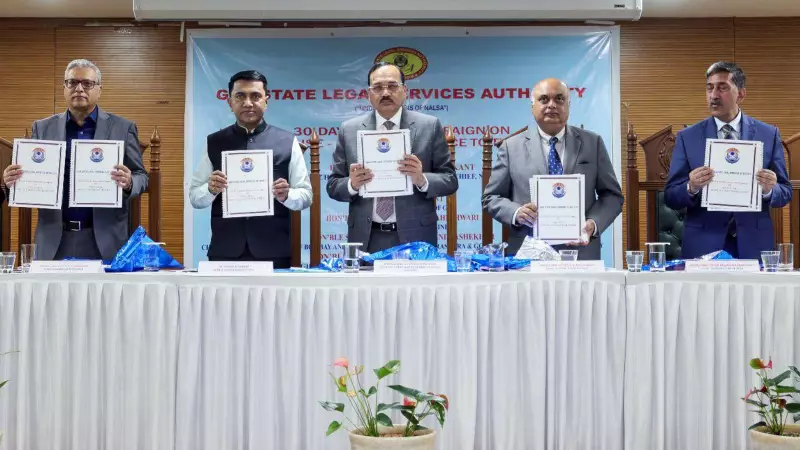
Chief Justice of India (CJI) Justice Surya Kant on Friday expressed profound grief over the devastating fire at a North Goa nightclub that claimed 25 lives earlier this month, terming the incident a "tragedy for the entire nation." The CJI's remarks came during a significant address in Porvorim, where he connected the broader societal challenge of substance abuse to the need for a compassionate legal framework.
A Nation Mourns: CJI's Condolences for Arpora Fire Victims
Speaking at the inauguration of a 30-Day Special Awareness Campaign on "Drug Abuse – Drugs: A Menace to Society" organized by the Goa State Legal Services Authority (GSLSA) under NALSA, Justice Surya Kant offered his heartfelt condolences. The fire at the Birch by Romeo Lane nightclub in Arpora, North Goa, on December 6, resulted in the deaths of 25 individuals, including five tourists.
"I wish to offer my heartfelt condolences regarding the recent tragedy in Arpora, Goa. We mourn the loss of many young lives… individuals who were there to enjoy a well-earned break, as well as those working hard to support their families. This is a profound loss for their loved ones and a tragedy for our entire nation," the CJI stated solemnly.
Beyond Punishment: A Reform-Oriented Approach to Drug Abuse
In his speech, the CJI delved into the pervasive issue of drug addiction, describing it as a reality that silently infiltrates ordinary lives. He noted that it often begins with curiosity or peer pressure but soon escalates, extracting a heavy public cost from families, education, and livelihoods.
Justice Kant emphasized that tackling substance abuse requires a collective effort from families, educators, health professionals, and communities, not just isolated legal responses. He clarified that while the law has a role, it should not be the first or only response in every case, especially those involving addiction.
The CJI outlined a clear legal distinction. For drug traffickers and those who profit from human vulnerability, the law must act "thoroughly, decisively and without hesitation." However, for first-time users, students, or young adults struggling with dependency, the focus must shift from mere culpability to recovery and rehabilitation.
"Punishment, by itself, cannot be the end. Justice must ask whether it is merely closing a case or preserving a future that might otherwise be lost. This approach is not leniency, it is realism," he asserted. The CJI advocated for a "calibrated balance of deterrence, treatment and social reintegration," highlighting the indispensable role of institutions beyond the courtroom.
Envisioning 'Multi-Door Courthouses' for Holistic Justice
Earlier on Friday, at the Bar Council of India's National Conference on Mediation in South Goa, CJI Surya Kant proposed a transformative vision for India's judicial system. He called for courts to evolve into "multi-door courthouses" – comprehensive centres for dispute resolution rather than mere venues for adversarial trials.
Under this model, individuals seeking justice would be presented with an array of options like mediation and arbitration, with litigation being the final recourse tailored to the dispute. He stressed that mediation is not a sign of the law's weakness due to pendency, but its "highest evolution" towards cultivating harmony over merely managing conflict.
The CJI assured that the judicial system remains prepared for fair trials where mediation or arbitration is unsuitable, ensuring the litigant is empowered with nuanced resolution methods. The event was also attended by Goa Chief Minister Pramod Sawant and other dignitaries, underscoring the collective resolve to address these pressing societal issues.