Chhattisgarh High Court Issues Stern Warning to Police Over Custodial Abuse Allegations
The Chhattisgarh High Court has issued stern directions to the state police administration, making it clear that any deviation from constitutional and statutory safeguards during arrest, remand, or custodial treatment will invite strict departmental action. The court's strong stance came while disposing of a writ petition that alleged serious custodial abuse and police excesses.
Court Emphasizes Restraint and Accountability
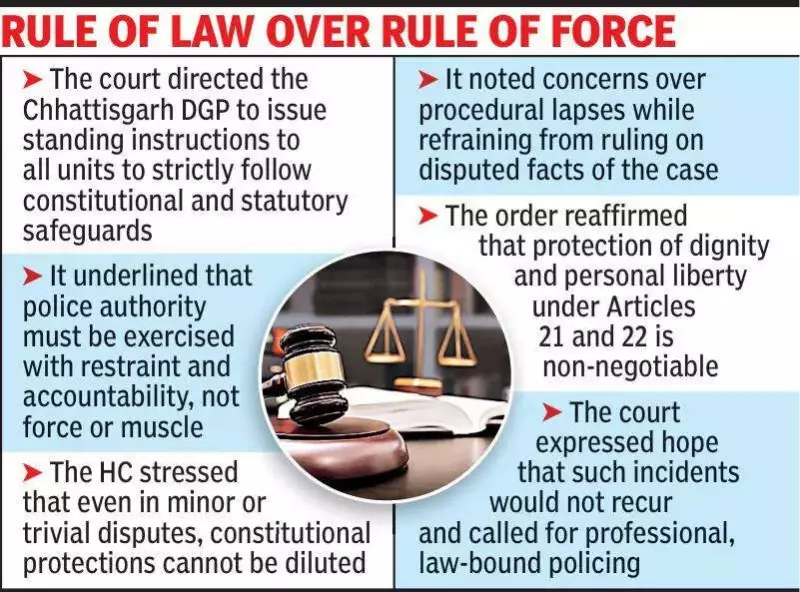
A division bench comprising Chief Justice Ramesh Sinha and Justice Ravindra Kumar Agrawal emphasized that police authority must be exercised with restraint, accountability, and scrupulous adherence to the rule of law. In its order passed on January 21, the court categorically observed that "any form of custodial abuse or harassment is wholly unacceptable" and directed the Director General of Police (DGP) of Chhattisgarh to issue appropriate standing instructions to all police units under his command.
The bench specifically underlined that illegal detention, unnecessary handcuffing, public parading, or any form of mental and physical humiliation of citizens cannot be tolerated, particularly in cases arising from trivial or minor public disputes. The court stressed that even while maintaining law and order, police officials are bound by constitutional mandates and binding judicial precedents.

Allegations of Custodial Abuse in Bhilai Case
The petition was filed by five residents of Bhilai in Durg district, who alleged that following a minor verbal exchange inside a cinema hall in October 2025, police personnel from Smriti Nagar Chowki acted in a high-handed manner. The petitioners claimed they were:
- Illegally detained without proper procedure
- Subjected to physical and mental torture
- Unnecessarily handcuffed during custody
- Publicly paraded in violation of their dignity
The petitioners maintained these actions violated constitutional safeguards and established Supreme Court guidelines regarding arrest and custodial treatment.
State's Defense and Police Response
The state government, represented by Advocate General Vivek Sharma, denied all allegations of custodial torture and excess. The state maintained that police action was lawful and based on a written complaint by a woman alleging misbehavior and assault in a public place.
The Director General of Police filed a personal affidavit before the court asserting that:
- Procedural safeguards were properly followed during the incident
- Medical examinations were conducted as required by law
- Allegations of public parading were misconstrued due to a mechanical failure of a police vehicle
- A show-cause notice had already been issued to the concerned station house officer
High Court's Comprehensive Directives
The High Court noted that the matter involved serious allegations concerning police conduct and stressed that the object of its directions was to safeguard citizens' dignity and liberty while preventing recurrence of illegal or disproportionate police action. The court issued specific directives to both the state government and police department:
Police personnel must unfailingly follow the guidelines laid down by the Supreme Court in landmark cases including Arnesh Kumar, Satender Kumar Antil, and D K Basu, particularly in matters relating to arrest, detention, and treatment of accused persons.
The state government and Police Department were instructed to ensure that procedures related to arrest, remand, medical examination, and custodial treatment are scrupulously followed in both letter and spirit.
The court mandated that any deviation or lapse in following prescribed legal procedures shall be promptly examined and dealt with through appropriate departmental action against erring officials.
Police authorities were earnestly directed to ensure that no citizen is subjected to harassment, humiliation, or custodial ill-treatment, and that the dignity, liberty, and fundamental rights of individuals are fully respected and protected at all times.

The court's comprehensive order serves as a significant reminder about the paramount importance of constitutional protections even during law enforcement activities, reinforcing the principle that police power must always be exercised within the boundaries of law and human dignity.