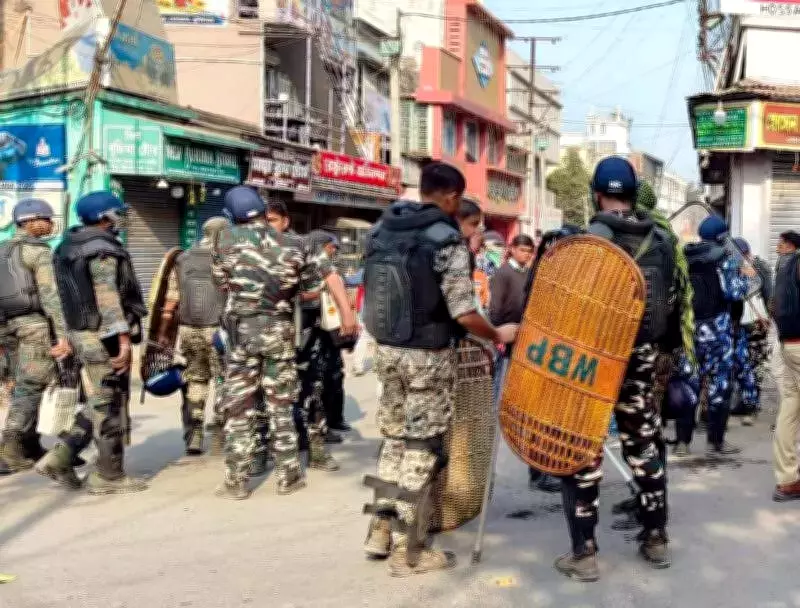
Calcutta High Court Upholds NIA Investigation in Murshidabad Violence Case
In a significant legal development, the Calcutta High Court on Thursday declined to grant an interim stay on the National Investigation Agency (NIA) probe into the violent incidents that erupted in Beldanga, Murshidabad district, in January. The court also upheld a trial court order mandating the handover of the case diary to the central agency.
Court Directs NIA to File Report by March 24
The division bench, comprising Chief Justice Sujoy Paul and Justice Partha Sarathi Sen, directed the NIA to submit its investigation report by March 24. This directive follows the Supreme Court's earlier referral of the case to the High Court to assess whether a prima facie case could be established under the stringent Unlawful Activities (Prevention) Act (UAPA).
The bench emphasized: "In order to come to a logical conclusion as to whether a prima facie case for investigation under UAPA was made out or not, the NIA is duty-bound to submit its report, post-investigation and during the investigation."
Further clarifying the necessity of the case diary, the bench added: "In order to enable the NIA to submit its report, it must obtain the case diary related to the case, without which it is practically impossible for the agency to submit its report."
State Government's Challenge and Legal Arguments
The West Bengal government had approached the High Court seeking an interim stay on the NIA probe. The state argued that its investigating agency had not initiated a case under UAPA, as the violence did not involve terrorist activities. Consequently, the state contended that the Centre's decision to transfer the investigation to the NIA could not withstand judicial scrutiny.
The state's counsel also requested a stay on the trial court's order to hand over the case diary to the NIA. It was highlighted that the local police station had registered the case under sections of the Bharatiya Nyaya Sanhita (BNS), the West Bengal Maintenance of Public Order Act, and the Prevention of Damage to Public Property Act.
NIA's Counterarguments and Incident Background
In response, the NIA's counsel submitted that a review of the written complaint indicated the accused had carried inflammable materials in containers with the intent to set fire to shops and vehicles, suggesting potential grounds for a UAPA investigation.
The violence in Beldanga stemmed from protests over the alleged murder of a local youth in Jharkhand. Demonstrators damaged property and blocked highways, leading to significant public disorder and necessitating a thorough investigation to determine the applicability of anti-terror laws.
This ruling underscores the judiciary's role in balancing state and central investigative authorities while ensuring a comprehensive examination of violent incidents that may have broader legal implications under national security statutes.