Calcutta High Court Denies Appeal in Divorce Case Citing Inordinate Delay
The Calcutta High Court has firmly refused to condone a significant two-year delay in the filing of an appeal against an ex parte divorce decree. This decision came on Wednesday, with the court highlighting apparent contradictions in the appellant's claims regarding her health and mobility during the period in question.
Court Questions Travel During Advanced Pregnancy
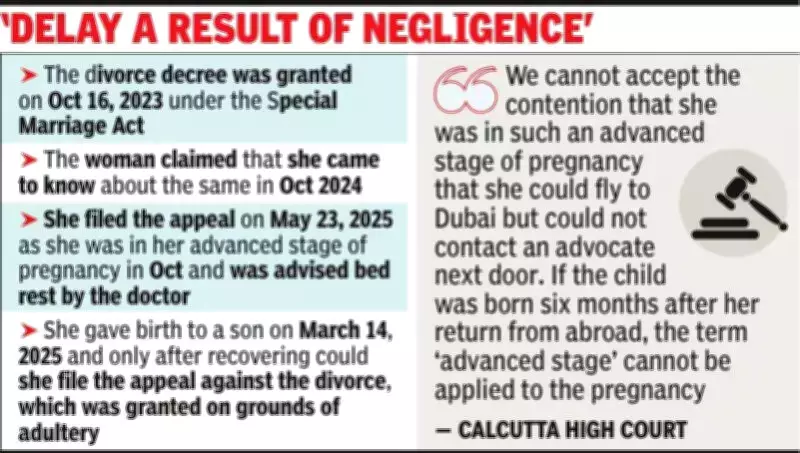
A division bench comprising Justices Sabyasachi Bhattacharyya and Supratim Bhattacharya delivered the ruling, which centered on the woman's failure to provide a satisfactory explanation for the delay. The bench pointedly observed that while the appellant claimed to be in an advanced stage of pregnancy requiring bed rest, she had nonetheless managed to travel to Dubai during this same period.
The court stated, "Thus, we cannot also accept the contention that she was in such an advanced stage of pregnancy that she could fly to Dubai but could not contact an advocate next door. If the child was born six months after her return from abroad, the term 'advanced stage' cannot be applied to the pregnancy."
Timeline of Events and Legal Proceedings
The original divorce decree was granted on October 16, 2023, under the provisions of the Special Marriage Act. The husband had cited grounds of adultery in his petition. The wife, however, contended that she only became aware of this decree in October 2024. Despite this claimed awareness, she did not file her appeal until May 23, 2025.
In her defense, the woman argued that she was in an advanced stage of pregnancy at the relevant time and had been medically advised complete bed rest. She gave birth to a son on March 14, 2025, and filed the appeal only after her recovery. However, the court noted her travel to Dubai on September 14, 2024, which occurred after she claimed to have received bed rest advice in August 2024.
Additional Legal Arguments Presented
The appellant raised several procedural objections to the original divorce proceedings. She argued that the trial court should not have proceeded with the hearing merely because a service notice was returned unclaimed. According to her submission, this notice was sent to an incorrect address, and she was not present in India at the time of its attempted service in July 2023.
Passport records indicated she had left India on October 28, 2022, and returned on September 19, 2023. Furthermore, she contended that under the Special Marriage Act, the alleged adulterer must be made a party to the proceedings—a step she claims was not followed in this case.
Court's Final Ruling on Delay
The bench explicitly chose not to delve into the substantive merits of these arguments. Instead, the rejection was based solely on the grounds of an inordinate and unexplained delay. The court emphasized the legal principle that valuable rights accrue to a party when the opposing side fails to act promptly without sufficient cause.
The judgment held, "Once a valuable right has accrued in favour of one party as a result of the failure of the other party to explain the delay by showing sufficient cause and its own conduct, it will be unreasonable to take away that right on the mere asking of the applicant, particularly when the delay is directly a result of negligence, default or inaction of the party."
This ruling underscores the judiciary's strict adherence to procedural timelines and the requirement for litigants to provide cogent explanations for any delays in pursuing legal remedies, especially when their own actions appear inconsistent with their stated limitations.