Calcutta High Court Downgrades Murder Charge to Culpable Homicide in 2011 Wife Burning Case
The Calcutta High Court has made a significant ruling in a long-standing criminal case, reducing a murder charge to culpable homicide not amounting to murder for a man who set his wife on fire in 2011. The court observed that the husband's drunken state may have prevented him from forming the intent to kill, leading to this legal reclassification.
Case Background and Key Details
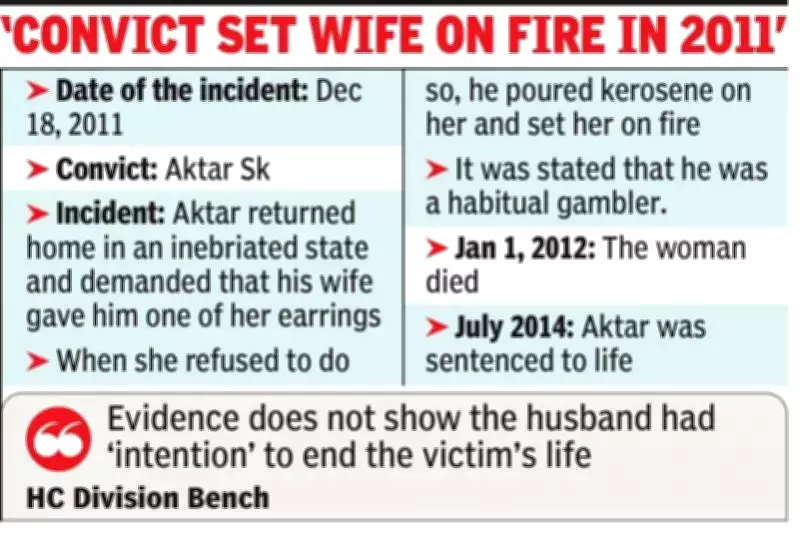
The incident dates back to December 18, 2011, when Aktar Sk returned to his Kolkata home in an intoxicated state. According to court records, he demanded his wife's earring, presumably to fund his gambling habit. When she refused, he allegedly set her on fire, resulting in severe burns that ultimately led to her death.
The couple had been married for 17 years at the time of the incident. Aktar Sk has spent 13 years in prison serving a life sentence for murder, but the maximum sentence for culpable homicide not amounting to murder is only 10 years under Indian law.
Court's Reasoning and Observations
A division bench comprising Justice Rajasekhar Mantha and Justice Md Shabbar Rashidi delivered the judgment, providing detailed reasoning for their decision to reduce the charge.
The court specifically noted: "Had he not been drunk, he may not have committed the murder." This observation formed a crucial part of their assessment of the defendant's state of mind and intent at the time of the crime.
The bench further explained that if Aktar Sk had truly intended to kill his wife, he would not have taken certain actions after the incident. These included:
- Calling a "quack" (unqualified medical practitioner) to treat her burns
- Hiring a taxi to transport her to her paternal home
- Arranging for her admission to Anupnagar BPHC Hospital for medical care
Evidence and Legal Analysis
The court carefully examined the available evidence in this complex case. While the wife's dying declaration to doctors at both Anupnagar and Jangipur SD Hospitals clearly established that Aktar Sk committed the act of setting her on fire, the evidence failed to prove he had the specific intention to cause her death.
Key evidentiary issues noted by the court included:
- No witnesses directly testified against the husband—two turned hostile while others provided only hearsay evidence
- No record of previous complaints by the victim or her family against the husband
- No evidence of torture or domestic violence prior to the incident
- The complainant (victim's brother) failed to notify police from December 19, 2011, to January 1, 2012
The bench stated: "Evidence does not show the husband had 'intention' to end the victim's life... There is no evidence on record of any torture by the husband on the victim. No previous complaint was lodged by the victim and her family."
Legal Implications and Section Analysis
The court's analysis extended to specific sections of the Indian Penal Code. The judgment indicated that the evidence was insufficient to support a conviction under Section 302 (murder) and equally inadequate for charges under Section 498A (cruelty by husband or relatives).
This ruling highlights the critical distinction in Indian criminal law between murder (requiring specific intent to cause death) and culpable homicide not amounting to murder (where death results from an act done with knowledge that it is likely to cause death, but without the specific intent to kill).
The case now returns to the trial court for sentencing under the reduced charge of culpable homicide not amounting to murder, with the maximum penalty being 10 years imprisonment—significantly less than the life sentence Aktar Sk has already served for the original murder conviction.