Bombay High Court Delivers Landmark Ruling on Religious Conversion Evidence
In a significant judgment, the Nagpur bench of the Bombay High Court has unequivocally declared that the mere presence of a Cross or a statue of Jesus Christ inside a residential dwelling cannot be construed as definitive proof that an individual has converted to Christianity or has relinquished their Hindu caste identity. This pivotal ruling underscores the necessity for concrete, documentary evidence to substantiate claims of religious conversion, thereby setting a crucial legal precedent.
Court Mandates Documentary Proof Over Symbolic Inferences
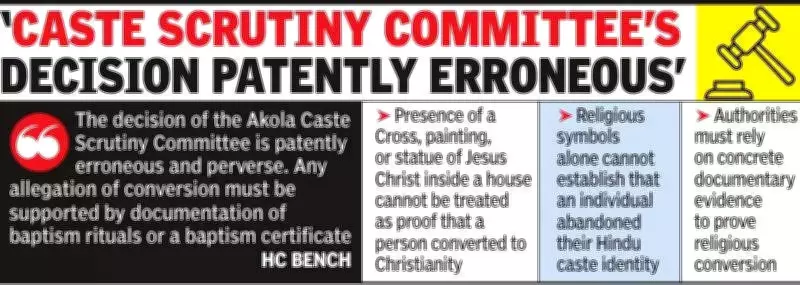
A division bench comprising Justices Mukulika Jawalkar and Nandesh Deshpande emphatically stated that allegations of religious conversion must be firmly supported by tangible documentary evidence. The judges explicitly noted that such claims cannot be inferred merely from the existence of religious symbols within a household. "Any allegation of conversion must be supported by documentation of baptism rituals or a baptism certificate," the bench observed, highlighting the rigorous standard required for legal validation.
Case Background: Student's Caste Certificate Challenge
The ruling emerged from a petition filed by an Akola-based college student, represented by counsel U J Deshpande, who contested the rejection of his application for a Scheduled Caste certificate by the Akola Caste Scrutiny Committee. The committee had concluded that the student's forefathers had converted to Christianity, thereby disqualifying him from receiving a Dalit caste certificate. To justify this decision, authorities had relied on two primary factors:
- The presence of a Cross and images of Christ in the family's residence.
- A school record from 1962 that described the family as Christian.
Court Rejects Committee's Reasoning as Flawed
The bench firmly rejected the scrutiny committee's reasoning, asserting that such circumstances alone are insufficient to establish a change in religion. The judges emphasized that the committee must thoroughly examine whether formal religious conversion rituals were actually performed before arriving at any conclusion. During the proceedings, the petitioner argued that his family had never formally converted to Christianity. According to submissions, his grandfather had identified as Christian in school records during his student years solely to avoid caste discrimination, with no actual religious conversion taking place.
Petitioner's Evidence and Court's Final Verdict
The petitioner bolstered his case with several official records, including school and government documents, as well as a caste validity certificate previously issued to a relative, which recognized the family's Scheduled Caste status. After meticulously examining all material on record, the court found the district authorities' reasoning to be legally unsustainable. Describing the Akola Caste Scrutiny Committee's decision as "patently erroneous" and "perverse," the court set aside the order rejecting the student's application. Consequently, the bench directed the concerned authorities to issue a Scheduled Caste certificate to the petitioner within a strict timeframe of two months.
Key Takeaways from the Bombay High Court Ruling
- The presence of a Cross, painting, or statue of Jesus Christ inside a house cannot be treated as proof that a person converted to Christianity.
- Religious symbols alone cannot establish that an individual abandoned their Hindu caste identity.
- Authorities must rely on concrete documentary evidence to prove religious conversion.
- Acceptable proof may include records of baptism rituals or a baptism certificate.
- Caste Scrutiny Committees must verify whether formal conversion rituals were actually performed.
- The Akola committee's decision was termed "patently erroneous" and "perverse."
- Authorities have been directed to issue the petitioner a Scheduled Caste certificate within two months.
This judgment reinforces the principle that legal determinations regarding religious identity must be based on substantive evidence rather than superficial assumptions, ensuring fairness and accuracy in administrative and judicial processes.