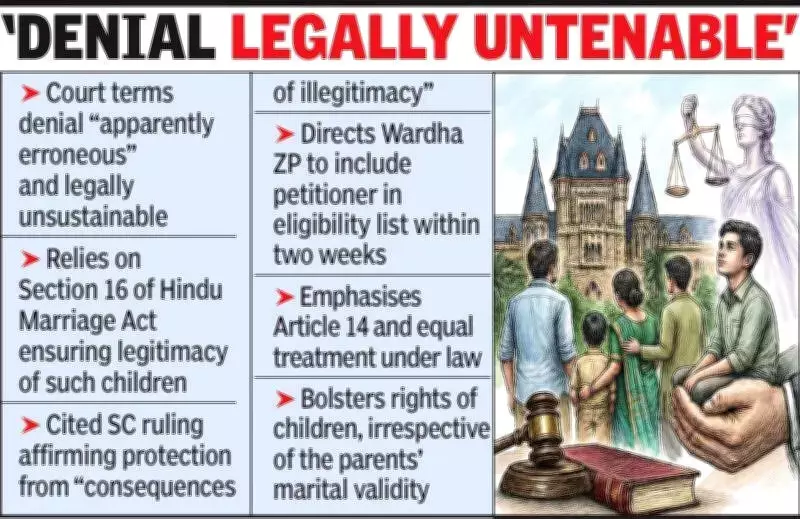
The Nagpur bench of the Bombay High Court has recently set aside the rejection of a young man's claim for compassionate appointment, ruling that denial based solely on his birth from a second marriage is legally untenable. The decision reinforces principles of equality and social justice.
Court's Ruling
A division bench comprising Justices Mukulika Jawalkar and Nandesh Deshpande quashed a communication issued by the Wardha Zilla Parishad on May 16, 2023, which had rejected the Arvi resident's petition on grounds that he was the son of the deceased employee's second wife. The petitioner challenged the Zilla Parishad's communication through his counsel, NR Saboo. The court directed the authorities to include his name in the list of eligible candidates 'if he is otherwise eligible' and complete the process within two weeks.
Background of the Case
The petitioner's father, a driver with the Zilla Parishad, died while still employed on March 23, 2003. At that time, the petitioner was about four years old. After attaining majority on January 15, 2017, he applied for compassionate appointment within a month and followed it up with representations. However, his claim was rejected citing the invalidity of his mother's marriage under Hindu law.

Legal Basis
The court held that the basis of denial was 'apparently erroneous.' It relied on Section 16 of the Hindu Marriage Act and the Supreme Court's ruling in Union of India vs VR Tripathi. 'Section 16 of the Hindu Marriage Act, 1955, says that even if a marriage is later declared null and void under Section 11, the child born from that marriage still remains legitimate. This protection does not depend on whether the child is born before or after 1976, or whether a court has passed a decree of nullity or not. Because of this law, the Zilla Parishad's order treating the child as illegitimate is wrong and cannot be allowed,' the judges said.
Quoting the apex court, the bench noted, 'Legitimacy of a child born from a marriage which is null and void is a matter of public policy to protect a child from suffering the consequences of illegitimacy.' The court underscored that such children cannot be denied benefits solely due to circumstances of birth, aligning the ruling with constitutional guarantees under Article 14.
Implications
This judgment sets a significant precedent for compassionate appointment cases where the legitimacy of a child is questioned due to the marital status of parents. It affirms that children born from void or voidable marriages are entitled to the same rights as those born from valid marriages, in line with the protective intent of the Hindu Marriage Act and the Constitution.