

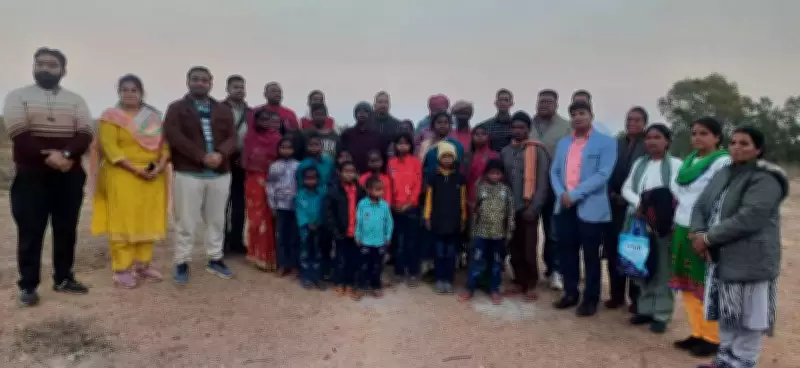
Ten Birhor Children Rescued After Seven-Day Ordeal, Reunited with Families in Koderma
In a heartwarming conclusion to a week-long saga of anguish, ten children from the Birhor tribal community were safely reunited with their families on Sunday evening. The emotional reunion took place at the Birhor hamlet of Gadiyai in Jharkhand's Koderma district, bringing immense relief to a community that had been gripped by fear and uncertainty.
A Community's Agony Turns to Relief
The settlement, home to 210 Birhors across 38 families, had been plunged into profound grief since January 31st. The children vanished after attending a feast approximately three kilometers from their hamlet. For seven agonizing days, families endured what one parent described as a living nightmare.
"If my children were not found, I would have died," said Danku Birhor, whose four children were among those missing. Another parent, Rajesh Birhor, whose two children were also part of the group, revealed the personal toll: "I did not take food for two days. Now, I will enjoy my meal."

As the sun set over Jainagar, tears of joy replaced tears of sorrow. One mother, clutching her rescued child, vowed through her tears to never let him out of her sight again, calling the experience a permanent personal lesson.
The Disappearance and Rescue Operation
The children's ordeal began when they accidentally boarded the wrong train at Parsabad station. Missing their intended stop at Yadudih, located near their settlement, they disembarked at Gaya in Bihar and began wandering on foot.
Alert locals in Gaya noticed the group and contacted police, who transferred the children to Childline. Authorities initially faced significant challenges due to language barriers with the children, who belong to one of Jharkhand's most primitive tribes.
The children were temporarily housed in various shelter homes across Gaya, Nawada, and Aurangabad while officials worked to establish communication and identify their origins.
Police Response and Breakthrough
Following a formal missing persons report filed on Friday, Koderma police launched an intensive search operation. Superintendent of Police Anudeep Singh formed eight specialized teams and announced a reward of one lakh rupees for information leading to the children's whereabouts.
The breakthrough came on Saturday when Koderma police received information about the children's location in Bihar. SP Anudeep Singh personally led a team of senior officers to Bihar to facilitate the children's return. After completing necessary legal formalities on Sunday, the children were officially handed over to their parents.
Official Presence and Community Response
The reunion ceremony was attended by circle officer Saransh Jain, Block Development Officer Gautam Kumar, Jainagar police station officer-in-charge Umanath Singh, and village mukhiya Rajendra Yadav.
Circle officer Saransh Jain noted the palpable joy on family members' faces, describing the homecoming as "a deeply moving scene for the administration and the community at large."
Koderma Deputy Commissioner Rituraj expressed relief at the safe rescue and outlined comprehensive plans for the Birhor community's welfare. With approximately 1,900 Birhors across 21 villages in Koderma, the administration plans to implement measures to prevent similar incidents.
Long-Term Welfare Measures Announced
The DC announced that 'Sevikas' would be assigned to monitor children's movements, and a community head would be appointed to foster better social cohesion. A comprehensive roadmap, personally monitored by the DC's office, will be implemented to improve the tribe's social, economic, and mental well-being.
Village mukhiya Rajendra Yadav acknowledged the administration's rescue efforts but urged more sustained action to uplift Birhor families' overall conditions. "It was a matter of great relief that the missing children were brought back safely," he stated, while emphasizing the need for continued support for the vulnerable community.
The successful rescue operation and emotional reunion have highlighted both the vulnerabilities of tribal communities and the effectiveness of coordinated administrative response in crisis situations.






