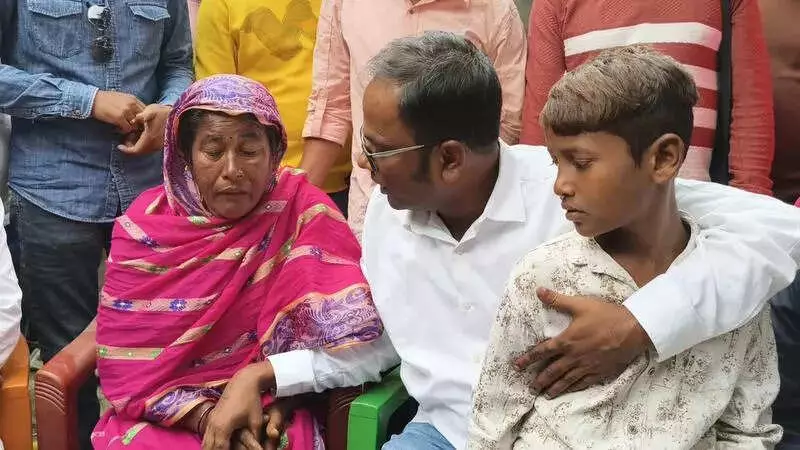
A tale of two families from the same Birbhum district in West Bengal has unfolded with starkly different outcomes, highlighting a complex humanitarian and legal crisis. While one mother has returned to India after an illegal deportation, another remains stranded across the border, her family gripped by despair.
A Partial Homecoming and a Lingering Wait
Sunali Khatun, aged 26, and her eight-year-old son Shabir have returned to their home in Birbhum. Their return was facilitated on humanitarian grounds by the Centre following a Calcutta High Court order. They landed in India on Saturday night. However, their homecoming has deepened the anguish for another family residing just a kilometre away in Paikar village.
Sweety Bibi, a 32-year-old single mother, along with her two sons Kurban (16) and Imam (6), remains in Bangladesh. They were part of the same group of six individuals—including Sunali, her husband Danish Sheikh, and their son—who were held in Delhi on charges of being illegal settlers, flown to Guwahati, and pushed into Bangladesh based on an order from the Delhi Foreigners Regional Registration Office (FRRO).

Legal Battle and a Child's Plea
The Calcutta High Court, hearing a habeas corpus plea filed by Sweety's cousin Amir Sheikh on July 8, quashed the FRRO order. A division bench of Justices Tapabrata Chakraborty and Reetobroto Kumar Mitra cited procedural lapses in the deportation process and directed that all six individuals be brought back to India.
This judgment was later challenged before a Supreme Court bench. The apex court suggested the Centre bring back Sunali and her minor son. However, Sweety Bibi and her children, along with Sunali's husband, are still awaiting their return.
Sweety's mother, 50-year-old Rozina Bibi, questions the disparity. "If the high court asked all six to be brought back, why was my daughter not being allowed in?" she asks. The emotional toll is most visible on Sweety's third child, 10-year-old Imran, who stays with his grandparents. His first reply to any call enquiring about his mother is: 'They took my mother, when will they return her to me?'
Rozina expressed the difficulty of explaining the situation to her grandson. "He is hearing that Sunali is returning, naturally his questions on his mother's whereabouts have increased further." The family has been given repeated assurances, with officials stating it would take "another two to three days," a refrain they have heard since the High Court order on September 26.
A Family's Struggle and Hope for Resolution
The past six months have brought immense emotional and financial turmoil to Sweety's family. Rozina recalls how she, Sunali's father Bhodu, and mother Jyotsna would often meet and cry over the fate of their daughters. "Today, one of them has returned. We are happy for Sunali's parents. But why not my daughter as well?" she asks.
The hardship is compounded by Sweety's role as the family's sole breadwinner. Her husband, Azizul Dewan, went missing four years ago in Tamil Nadu. Since then, Sweety single-handedly supported her aged and ailing parents, Rozina and 60-year-old Saizul Sheikh, by working as a house help in Delhi.
Samirul Islam, chairperson of the West Bengal Migrant Workers' Welfare Board, provided a glimmer of hope. He stated that the Supreme Court is set to hear the case again on December 12. "We are very hopeful that Sweety and her two minor children, and Sunali's husband will be allowed to return home, too," he said.
The case underscores the critical importance of due process in matters of deportation and the profound human cost when such procedures are flawed. For now, a family in Paikar village continues to wait, their lives on hold, clinging to the hope of a complete reunion.