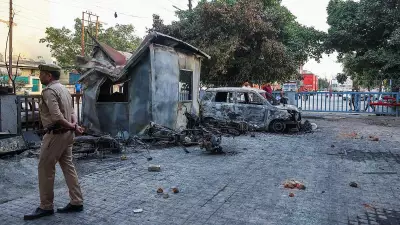
Bijapur District Emerges as India's Improvised Explosive Device Epicenter
RAIPUR: While Bastar's Bijapur district has long been recognized as a Maoist stronghold, it has now solidified its position as India's undisputed epicenter for improvised explosive devices. Despite significant reductions in armed Maoist formations and increasing surrender rates, this south Bastar region accounts for an overwhelming majority of IEDs being planted and recovered across the entire nation.
The Silent Threat Beneath the Surface
Although gunfire exchanges have diminished, the ground itself remains heavily weaponized. In a recent incident on Thursday, CRPF personnel recovered a massive 30-kilogram IED buried approximately two feet deep beneath a metal road on the Awapalli-Basaguda route. Positioned just three kilometers from a police station, this command-detonated device featured a 100-meter-long wire for manual triggering and possessed sufficient explosive power to destroy a Mine Protected Vehicle or a large bus.
While CRPF bomb disposal teams successfully defused this particular device during demining operations, security concerns remain as elevated as in previous years. The incident underscores a fundamental transformation in the Maoist conflict strategy—from open armed confrontation to a hidden, buried warfare dominated by landmines and explosive traps.

Alarming Statistical Patterns
Official CRPF data for 2025 reveals a stark geographical concentration of IED activity. Of the 716 improvised explosive devices detected during nationwide demining procedures this year, an astonishing 679 were recovered in Chhattisgarh alone. Within that state total, Bijapur district accounted for 652 devices—representing over 90% of national recoveries.
The pattern intensifies when examining the last quarter of 2025 (October-December). During this period, 101 IEDs were seized across India, with 92 found in Chhattisgarh and 80 specifically in Bijapur. The state's overall contribution of 679 recoveries constitutes nearly 95% of the national total, highlighting how completely the Maoist conflict has transformed from traditional gun battles to underground explosive warfare.
Security Officials Voice Grave Concerns
Security personnel stationed in the region emphasize that no other district in India approaches Bijapur's concentration of explosive threats. "This represents our most significant challenge currently," explained a senior CRPF officer posted in Bastar. "These are weapons that remain invisible until triggered. Previously, Maoists relied primarily on armed confrontation, but as that operational space has contracted, IEDs have emerged as their primary weapon system."
Approximately 90% of recovered devices are classified as victim-operated IEDs, triggered through pressure, pull, lift, or tilt mechanisms. Unlike command-detonated explosives, these VOIs lie silently beneath forest tracks, culverts, and newly constructed roads—particularly those connected to road-opening parties and camp supply routes.
Government Response and Technological Solutions
Deputy Chief Minister and Home Minister Vijay Sharma confirmed that recent recoveries and incidents indicate continued fresh planting of explosive devices. Bastar Range Inspector General of Police P Sundarraj acknowledged the persistent threat, stating that Maoists increasingly depend on IEDs to mark their presence and inflict damage, necessitating comprehensive demining operations despite continuous recoveries by security forces.
Regarding potential technological solutions, Sundarraj explained, "While we currently employ deep metal detectors for IED recovery, senior officials are exploring advanced technologies like ground penetration radar. This system detects soil disturbances and could significantly enhance demining effectiveness. However, the technology requires customization for Bastar's unique topography and dense jungle conditions."
The police official noted significant increases in IED recoveries—308 devices in 2024 followed by a major surge to 894 in 2025—attributing this to strengthened ground intelligence, improved surveillance capabilities, and intensified area domination and search operations. This sharp rise suggests that numerous potential IED attacks have been neutralized before execution.

Tactical Shift in Maoist Strategy
Security experts describe the surge in IED usage as a major strategic adaptation by Maoist cadres who find themselves increasingly pressured. Expanded road networks, establishment of new security camps, drone surveillance, and intensified operations have reduced what officials previously termed "security vacuums," making large-scale armed confrontations increasingly risky for insurgent groups.
"For this buried warfare approach, Maoists don't require large groups to engage security forces," the CRPF officer elaborated. "A single properly placed device can stall an entire company's movement." Correspondingly, cadres have abandoned distinctive black uniforms and visible weapons, instead posing as villagers, laborers, and farmers to avoid detection.
Crude Materials, Devastating Consequences
Most recovered devices are locally assembled using readily available materials from mining zones, including gelatin sticks, urea, nails, kerosene oil, and cordex wire. Despite their crude construction, these explosives produce brutal effects.
Security officials report that IED blasts account for the majority of injuries among personnel, frequently resulting in limb loss, severe shrapnel wounds, and blindness. Even sniffer dogs deployed for detection have suffered significant injuries during operations.
"The moment an explosion occurs, approximately half the unit immediately shifts to casualty management," the CRPF official described. "Evacuation becomes the absolute priority, which inherently slows broader anti-Naxal operations."
National Context and Future Outlook
Union Home Minister Amit Shah recently reiterated March 31, 2026, as the target date for eliminating residual armed Maoist presence during his visit to Chhattisgarh. While surrender and arrest figures have increased and major Maoist formations have fragmented, the IED network remains alarmingly active.
"Maoism may be approaching its brink in terms of open armed struggle," one officer observed. "But the buried war continues unabated."
National statistics for 2025 provide additional context:
- Total IED blasts across India: 41
- Blasts in Chhattisgarh: 24
- Blasts specifically in Bijapur: 19
- Total security personnel injured nationwide: 44
- Injuries in Chhattisgarh: 28
- Injuries in Bijapur: 23